

Cheapest Saree Market in India: Wholesale Buyer Guide
Cheapest Saree Market in India: Complete Wholesale Buying Guide

If you are searching for the cheapest saree market in India, the first thing to understand is that there is no single market that will be cheapest for every type of saree.
A retailer looking for budget georgette and printed sarees may find Surat highly competitive, while a store specialising in Bengali cotton sarees may have stronger sourcing opportunities around Kolkata. Jaipur has its own strength in Bandhani, Leheriya and printed textiles, while Varanasi is better known for Banarasi silk and traditional woven sarees.
For retailers, boutique owners and resellers, therefore, the right question is not simply “Where is the cheapest saree market?” It is:
Which market can give me the best landed cost, saleable designs, reliable quality and enough margin for my target customers?
For a large range of fashion, synthetic, printed, georgette, party-wear and catalogue sarees, Surat is one of the strongest wholesale sourcing hubs to evaluate in India.
Which Is the Cheapest Saree Market in India?
For many budget and mid-range fashion saree categories, Surat is one of the most competitive wholesale sourcing centres in India, particularly because of its large textile manufacturing and trading ecosystem.
However, “cheapest” depends on the saree category, fabric, quantity, work, MOQ, supplier level, packing and freight.
A buyer should compare the final landed cost, not only the supplier's quoted per-piece price.
Surat's wholesale scale is substantial. A recent Surat Municipal Corporation planning document describes approximately 165 textile-market buildings and around 65,000 wholesale agents, concentrated mainly around the Ring Road and Sahara Darwaja influence area.
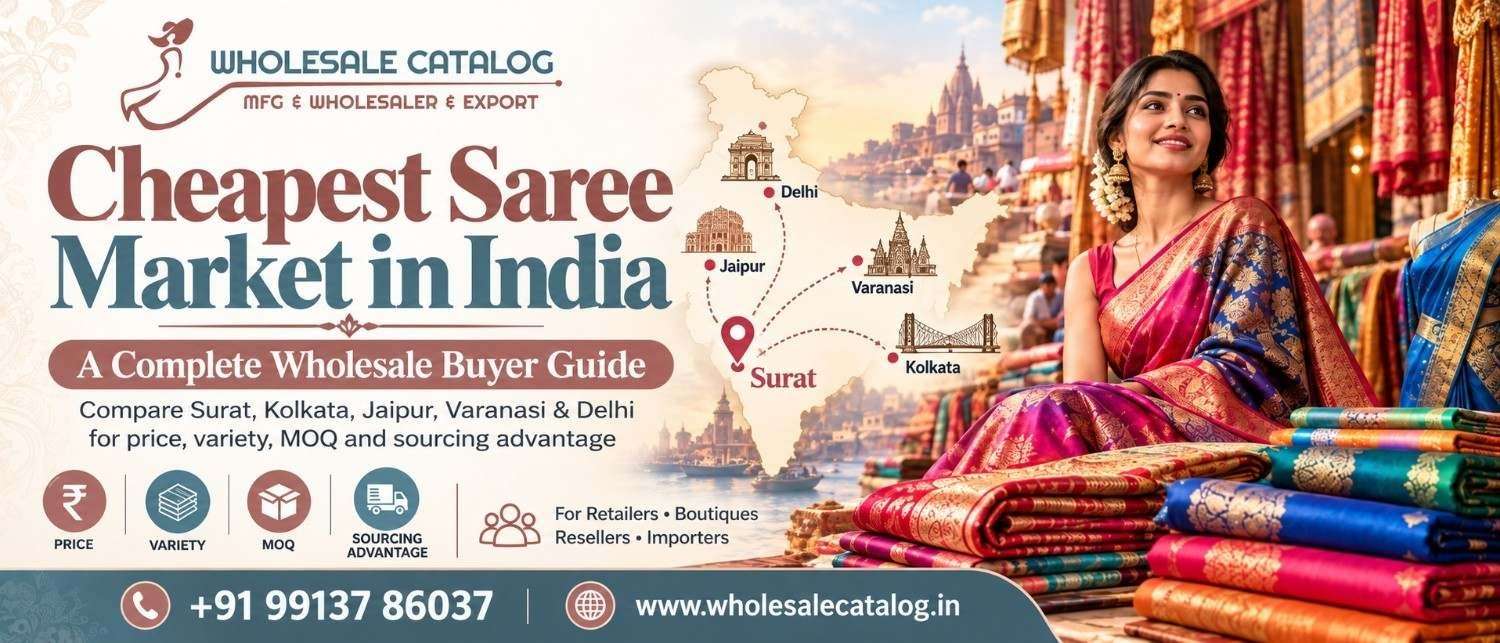
Cheapest Saree Markets in India: Quick Comparison
| Sourcing Hub | Particularly Useful For | Buyer Profile |
|---|---|---|
| Surat, Gujarat | Printed, georgette, synthetic, designer, party-wear and catalogue sarees | Retailers, online sellers, wholesalers, exporters |
| Kolkata, West Bengal | Bengali cotton, Tant-style, linen and regional collections | Boutiques and regional saree retailers |
| Jaipur, Rajasthan | Bandhani, Leheriya, prints and traditional designs | Boutiques, ethnic stores and festive sellers |
| Varanasi, Uttar Pradesh | Banarasi, silk, brocade and wedding sarees | Premium and bridal retailers |
| Delhi | Multi-category trading and redistribution | North India retailers and mixed-fashion stores |
This comparison explains why choosing the cheapest location only by city name can be misleading.
A Varanasi silk saree and a mass-produced georgette fashion saree are entirely different products. Their manufacturing processes, fabrics, customer segments and selling prices are not directly comparable.
Why Surat Is a Major Low-Price Saree Sourcing Hub
Surat's biggest advantage is its textile ecosystem.
Manufacturing, fabric processing, designing, embroidery, printing, trading, cataloguing, packing and transportation are interconnected within a large commercial network.
That creates several benefits for wholesale buyers.
Large Supplier Competition
When many manufacturers, traders and catalogue suppliers operate within the same sourcing cluster, buyers get access to many competing collections.
More choice makes it easier to compare:
- fabric
- design
- catalogue quantity
- price
- workmanship
- stock availability
- expected retail value
Instead of depending on a single supplier, a retailer can build a sourcing mix.
Strong Synthetic and Fashion Textile Ecosystem
Surat has particularly strong capabilities in man-made fabrics and fashion-oriented textile production.
Invest India has described Surat as Gujarat's “textile city” and highlighted its large raw- and processed-fabric production ecosystem.
This is especially relevant to sellers dealing in fashion sarees where frequent design changes, competitive pricing and scalable production are important.
New Collections Across Different Price Segments
A retailer may need ₹500-range saleable products for one customer group and premium festive sarees for another.
That is why variety can sometimes be more valuable than simply finding the lowest-priced article.
A supplier capable of offering multiple price brackets allows the retailer to create a balanced inventory.
Surat Saree Wholesale Market: Where Buyers Usually Source

The Ring Road and Sahara Darwaja belt forms an important part of Surat's textile trading ecosystem. Surat Municipal Corporation records also identify numerous textile-market properties around Ring Road and Sahara Darwaja.
For a physical-market buyer, a typical sourcing trip may involve visiting several suppliers, checking catalogues and negotiating based on quantity.
However, physical sourcing has additional costs:
- travel
- hotel
- local transport
- staff time
- sample carrying
- parcel handling
- repeated market visits
A quotation that appears ₹20 or ₹30 cheaper per piece is not necessarily cheaper after these costs are included.
This is why retailers increasingly compare physical market purchasing with online wholesale saree sourcing.
What Does “Cheap Saree” Actually Mean for a Retailer?
Suppose Supplier A offers a saree at a lower purchase price than Supplier B.
At first glance, Supplier A looks cheaper.
But then consider:
Supplier A
- lower product price
- larger compulsory catalogue
- weaker finishing
- higher transport cost
- slow-moving designs
Supplier B
- slightly higher purchase price
- lower MOQ
- more saleable colours
- better finishing
- better repeat availability
Supplier B may produce a higher actual profit.
For a retailer, therefore:
True Saree Cost = Product Cost + GST + Packing + Freight + Inventory Risk + Unsold Stock Cost
This is effectively your landed inventory cost.
The goal should be the lowest commercially sensible landed cost—not simply the lowest invoice rate.
Wholesale Saree Prices: What Buyers Should Expect

Wholesale prices can vary significantly according to:
- fabric
- weaving method
- printing
- embroidery
- zari
- embellishment
- blouse fabric
- finishing
- design complexity
- manufacturer
- catalogue size
- order volume
Current WholesaleCatalog.in listings demonstrate how wide that variation can be. During this review, some georgette wholesale listings were displayed around ₹399–₹480 per piece, while other catalogue collections were priced at ₹700, ₹1,000 or considerably higher depending on the product. Prices and availability can change, so buyers should always verify the current catalogue before ordering.
This is another reason not to advertise one fixed “cheapest saree price in India.”
Instead, compare products within the same fabric, quality and buyer segment.
Surat vs Kolkata Saree Wholesale Market

Kolkata is an important sourcing option, particularly when your customers are interested in Bengal-influenced cotton, linen and traditional saree categories.
Surat, by comparison, is particularly practical for retailers focused on:
- fashion sarees
- synthetic sarees
- printed collections
- georgette
- embroidery
- party wear
- catalogue-based products
A store can also source from more than one city.
For example:
Surat: Fashion and party-wear inventory
Kolkata: Cotton and regional designs
This creates a stronger product assortment than forcing every purchase through one market.
Buyers researching Bengal-based sourcing can also read our guide to the wholesale saree market in Kolkata:
https://www.wholesalecatalog.in/detail_blog/wholesale-saree-market-in-kolkata-online/
Surat vs Jaipur for Wholesale Sarees
Jaipur is particularly strong where traditional Rajasthani textile styles matter.
The Rajasthan government highlights Bandhani, Leheriya, Kota Doriya and block printing among the state's important textile traditions and identifies Jaipur as one of Rajasthan's established textile hubs.
Therefore, a boutique specialising in:
- Bandhani
- Leheriya
- ethnic prints
- festive Rajasthan-inspired collections
may find Jaipur highly relevant.
For a volume fashion seller needing continuously changing synthetic or catalogue sarees, Surat may provide a different sourcing advantage.
Again, the cheapest city depends on what you intend to sell.
Surat vs Varanasi for Sarees
Varanasi should generally not be compared with Surat simply on lowest price.
Varanasi's strength is its traditional silk weaving and Banarasi textile heritage. Government MSME material describes Varanasi as an important silk-textile producing centre known for silk sarees, brocades and zari-related craftsmanship.
A bridal boutique sourcing Banarasi sarees has different customer expectations from an online reseller selling affordable everyday fashion sarees.
Choose Varanasi when craftsmanship and premium traditional positioning are central to your business.
Choose a high-volume sourcing hub such as Surat when frequent designs, broader fashion price points and commercial inventory rotation are more important.
Is Delhi the Cheapest Saree Market?
Delhi is a major trading and distribution centre, but that does not automatically make it the cheapest manufacturing source for sarees.
Gandhi Nagar, for example, has a very large readymade-garment trading ecosystem. Delhi government material describes it as a major readymade garment market and has outlined plans to develop it further as a garment hub.
For North Indian retailers, Delhi can still make commercial sense because transportation and sourcing convenience may offset differences in product cost.
This highlights an important principle:
The nearest profitable wholesale market can sometimes be better than the technically cheapest factory location.
How Retailers Should Compare Saree Suppliers
Before placing a bulk order, compare at least five areas.
1. Product Quality
Check:
- fabric feel
- colour
- print alignment
- border finishing
- embroidery
- loose threads
- blouse piece
- actual product vs catalogue photo
Never judge a supplier only from highly edited images.
2. MOQ
MOQ means Minimum Order Quantity.
One supplier might quote a very attractive rate but require 12 or 20 pieces of one collection.
Another may allow five or six pieces.
For a small boutique, the second supplier can be financially safer even with a slightly higher per-piece rate.
3. Catalogue Mix
Ask whether you must purchase:
- complete catalogue
- selected designs
- selected colours
- single pieces
- mixed catalogue
For new sellers, smaller test quantities usually reduce inventory risk.
4. Repeat Availability
This matters more than many new retailers realise.
Suppose one design sells very well but the supplier cannot repeat it.
You lose an opportunity to restock a proven product.
Ask suppliers whether fast-moving catalogues can usually be repeated.
5. Replacement Conditions
Before purchasing, understand how damage, defects and incorrect goods are handled.
Keep invoice records and follow the supplier's required claim process.
Cheapest Saree Market for New Resellers
New resellers should not start by buying the largest quantity simply to obtain the lowest rate.
A better approach is:
- Choose 2–3 product categories.
- Identify your target retail price.
- Test small wholesale quantities.
- Track customer enquiries.
- Identify fast-moving colours and designs.
- Reorder products that perform.
- Increase quantities gradually.
For example, an Instagram saree seller may first test georgette, printed and festive sarees rather than purchasing 100 pieces of one style.
Low inventory risk is often more important than a ₹20–₹50 lower purchase rate.
Cheapest Saree Market for Boutique Owners
Boutiques generally need a different buying strategy.
Instead of filling the shop with identical low-cost products, focus on:
- exclusivity
- fabric
- finishing
- colour selection
- customer profile
- limited competition
- higher perceived value
A boutique can combine:
Budget Range: Daily/fashion sarees
Mid Range: Designer and festive pieces
Premium Range: Silk, bridal and occasion sarees
Such price segmentation gives customers more reasons to buy while reducing dependence on a single product category.
Cheapest Saree Market for Online Sellers
Online sellers should pay special attention to presentation and consistency.
Your cost includes more than the saree.
You may also spend on:
- photography
- marketplace fees
- advertising
- packaging
- courier
- COD charges
- returns
- customer support
Therefore, calculate profit after these expenses.
A product bought very cheaply but suffering high returns can become more expensive than a higher-quality saree with better customer acceptance.
Buying Wholesale Sarees Online vs Visiting Surat

Both approaches have advantages.
Physical Market Buying
Useful when:
- placing very large orders
- developing private collections
- inspecting fabrics personally
- meeting several manufacturers
- negotiating production
Online Wholesale Buying
Useful when:
- sourcing regularly
- avoiding travel
- testing smaller collections
- operating outside Surat
- comparing many catalogues remotely
- ordering from abroad
WholesaleCatalog.in allows retailers and resellers to browse current saree catalogues with information such as price, MOQ and product details. Current listings show different MOQ levels depending on the catalogue, reinforcing why buyers should compare quantity requirements along with price.
You can browse wholesale sarees from Surat here: https://www.wholesalecatalog.in/wholesale-sarees/
How to Reduce Dead Stock While Buying Cheap Sarees
Getting a low wholesale rate is useless if half the inventory remains unsold.
Use these practices:
Buy for Your Customer, Not Your Personal Taste
Study what actually sells in your city or online audience.
Test Colours
Different regions respond differently to colours and styling.
Watch Seasonal Demand
Wedding, festive and everyday-wear demand can require very different inventory.
Mix Price Points
Do not invest the complete budget in premium or extremely cheap merchandise.
Reorder Winners
Use sales data to increase purchases only after seeing actual demand.
This approach turns wholesale sourcing from guesswork into inventory management.
Questions to Ask a Saree Supplier Before Ordering
Before transferring money or confirming a catalogue, ask:
- What is the MOQ?
- Is the quoted price per piece or full catalogue?
- Is GST included or additional?
- What fabric is used?
- Does the saree include a blouse piece?
- Is the actual product similar to the catalogue photograph?
- What is the dispatch time?
- What shipping charges apply?
- What happens if an item arrives damaged?
- Can successful designs be repeated?
These questions can protect more profit than negotiating a few rupees from the product price.
Wholesale Sarees for International Buyers
Buyers in the USA, UK, Canada, Australia, UAE, Singapore, Malaysia, Mauritius and other international markets can also source Indian sarees without visiting every physical wholesale market.
International buyers should compare:
- product cost
- MOQ
- shipment weight
- courier/freight cost
- packing
- payment method
- destination import requirements
Import duties and taxes vary by destination, so they should be checked according to the buyer's country before placing a commercial shipment.
For a first order, testing the supplier and product quality before committing to substantially larger quantities can reduce sourcing risk.
Why Source Sarees Through WholesaleCatalog.in?
WholesaleCatalog.in is based in Surat and focuses on B2B sourcing for retailers, resellers, boutiques and wholesale buyers.
Instead of visiting multiple physical suppliers for every new collection, buyers can browse different saree catalogues online and compare product information before placing an order.
A buyer should still make the decision based on:
- design
- current price
- MOQ
- fabric
- customer demand
- expected retail margin
The goal is not simply to buy the cheapest saree.
The goal is to buy the right saree at a commercially workable wholesale price.
Final Verdict: Which Is the Cheapest Saree Market in India?
For buyers searching for the cheapest saree market in India, there is no universal winner for every saree category.
However, Surat deserves to be near the top of the shortlist for retailers buying budget and mid-range fashion sarees in volume, particularly synthetic, georgette, printed, embroidered, designer and catalogue-based collections.
For regional products, other markets may be more suitable:
- Surat: fashion, synthetic, printed and designer sarees
- Kolkata: Bengal-influenced cotton and regional sarees
- Jaipur: Bandhani, Leheriya and printed ethnic textiles
- Varanasi: Banarasi, brocade and silk
- Delhi: broad trading and redistribution access
The smartest retailer does not ask only:
“Where can I buy the cheapest saree?”
Ask:
“Where can I buy sarees my customers will actually purchase, at a landed cost that leaves me a healthy margin?”
That is the difference between cheap purchasing and profitable sourcing.
Frequently Asked Questions.
1. Which is the cheapest saree market in India?
There is no officially established single cheapest saree market for every product. Surat is one of the most competitive sourcing hubs for many synthetic, printed, georgette, designer and catalogue sarees, while other cities may offer stronger value for regional products.
2. Is Surat good for buying cheap sarees wholesale?
Yes. Surat has a very large textile manufacturing and wholesale ecosystem and is particularly relevant for fashion, synthetic, printed, embroidery and designer sarees.
3. What is the wholesale price of sarees in Surat?
Prices vary according to fabric, design, work, brand and quantity. Current online wholesale listings can range from a few hundred rupees per piece for selected fashion products to several thousand rupees for premium collections. Always check the live catalogue before ordering.
4. Where can I buy wholesale sarees online from Surat?
Retailers, boutique owners and resellers can explore current collections through WholesaleCatalog.in:
https://www.wholesalecatalog.in/wholesale-sarees/
5. Can I buy sarees in small wholesale quantities?
MOQ depends on the supplier and catalogue. Some collections permit relatively small quantities, while others require purchasing the full catalogue. Check the MOQ before confirming your order.
6. Which city is best for saree wholesalers in India?
It depends on the category. Surat is strong for fashion and synthetic sarees, Kolkata for several Bengal-oriented styles, Jaipur for Bandhani and Leheriya, and Varanasi for Banarasi and silk sarees.
7. Is buying sarees online cheaper than visiting a wholesale market?
It can be for buyers who would otherwise spend money on travel, accommodation and local transportation. However, larger buyers may still benefit from visiting manufacturers when negotiating major orders or customised production.
8. How should a reseller calculate profit on wholesale sarees?
Calculate the total landed cost, including product cost, taxes where applicable, transport, packing and selling expenses. Then compare this with a realistic retail selling price rather than relying only on the supplier's suggested margin.
9. Can international buyers order wholesale sarees from India?
Yes. International retailers and importers can source Indian sarees, but they should calculate shipping, minimum quantities and destination-specific customs or import requirements before ordering.
10. Is the lowest-price saree always best for reselling?
No. Quality, design demand, repeat availability, shipping, defects and unsold inventory can affect actual profitability. A slightly more expensive fast-selling saree may generate more profit than the lowest-priced product.
Source Wholesale Sarees Directly from Surat
Looking for sarees for your retail store, boutique, online shop or wholesale business?
Explore current wholesale collections at:
WholesaleCatalog.in
Wholesale Sarees: https://www.wholesalecatalog.in/wholesale-sarees/
Inquiry & Orders: +91 99137 86037
Compare designs, MOQ and price ranges and choose collections that match your customers and business model.


