

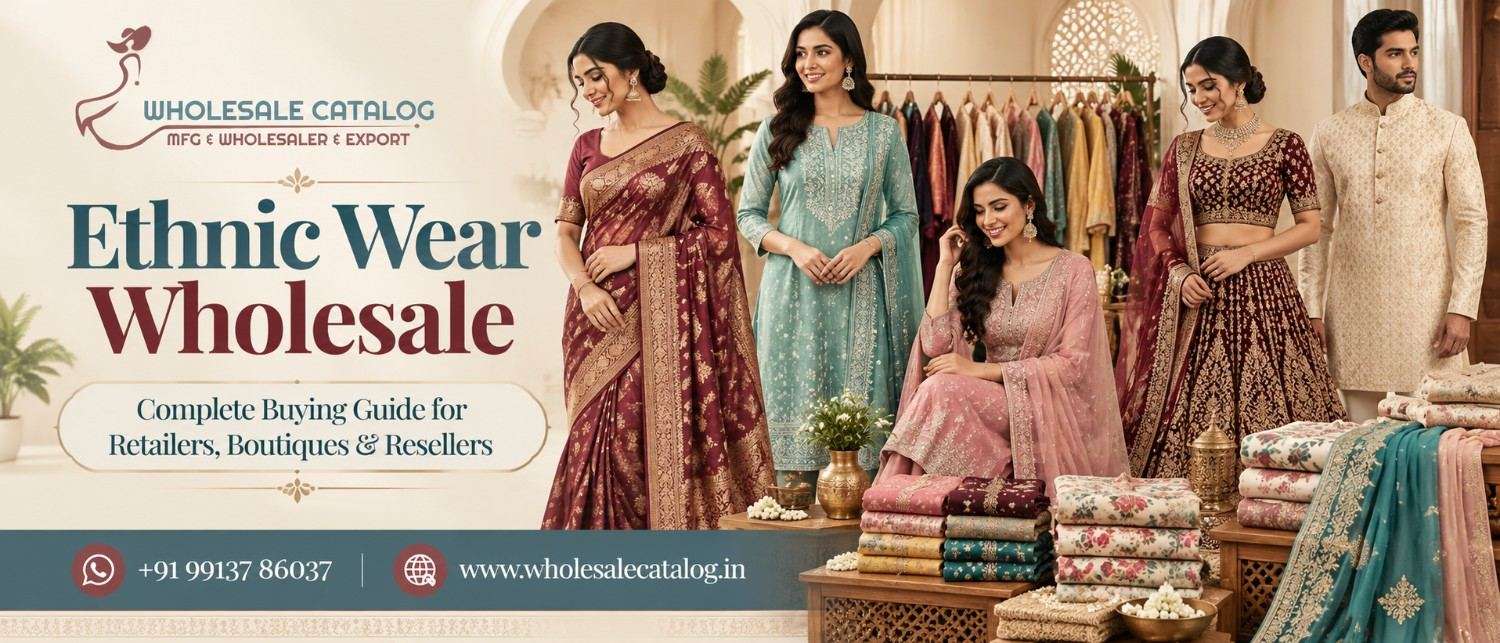
Ethnic Wear Wholesale: Complete Buying Guide for Retailers
Ethnic Wear Wholesale: Complete Guide for Retailers, Boutiques & Resellers
Indian ethnic fashion offers retailers something that few apparel categories can match: demand across daily wear, office wear, weddings, festivals, family functions and traditional occasions.
But building a profitable ethnic wear wholesale inventory is not simply a matter of finding attractive designs at low prices.
Retailers need to understand which categories fit their customers, how much inventory to purchase, which price points move quickly, whether sizes can be replenished and how the final landed cost affects the actual profit margin.
For boutique owners, resellers and online fashion businesses, the right wholesale strategy can be the difference between fast-moving inventory and capital locked in unsold stock.
This guide explains how to approach ethnic wear sourcing practically—from product selection and supplier evaluation to inventory planning and profit analysis.
If you're ready to browse products rather than research sourcing, explore the current Ethnic Wear Wholesale Collection on Wholesale Catalog. Explore Ethnic Wear Wholesale
What Is Ethnic Wear Wholesale?
Ethnic wear wholesale means purchasing Indian traditional and fusion clothing in business quantities for resale through retail shops, boutiques, websites, marketplaces, Instagram, WhatsApp or other selling channels.
The category is much broader than only kurtis and sarees.
A complete ethnic-wear assortment can include:
- Kurtis and kurta sets
- Sarees
- Salwar kameez
- Readymade suits
- Pakistani suits
- Dress materials
- Lehenga choli
- Anarkali suits
- Indo-western outfits
- Festive collections
- Wedding wear
- Men's kurtas and traditional menswear
WholesaleCatalog.in's existing ethnic-wear section currently includes products across several of these segments, demonstrating why ethnic wear is better treated as an overall retail category rather than a single product type. Wholesale Catalog
Why Ethnic Wear Wholesale Is Important for Retailers
1. Multiple Customer Segments
One of the biggest advantages of Indian ethnic clothing is its broad customer base.
A single retailer can potentially sell affordable cotton kurtis to daily-wear buyers while offering embroidered suits, premium sarees and lehengas to occasion-wear customers.
That gives businesses multiple price segments instead of depending on only one type of buyer.
2. Different Demand Occasions
Ethnic wear is purchased for many occasions:
Daily wear, office wear, college, pooja, weddings, engagement ceremonies, Diwali, Eid, Navratri, Raksha Bandhan and other family or cultural events.
The buying reason changes, so the retailer's inventory should change with it.
3. Wide Price Architecture
A strong store normally does not depend entirely on low-priced or premium stock.
A healthier range may include:
Entry level: simple, fast-moving styles.
Mid-market: better fabric, styling and detailing.
Premium: embroidered, designer, festive and wedding collections.
This allows retailers to increase average order value without abandoning price-sensitive customers.
Best Ethnic Wear Categories to Buy Wholesale
Wholesale Kurtis and Kurta Sets
Kurtis are useful for retailers because they can address daily, office, casual and festive demand.
Popular sourcing considerations include:
- Cotton and rayon fabrics
- Straight-cut designs
- Printed kurtis
- Embroidered kurtis
- Kurti-pant sets
- Plus-size options
- Festive kurta sets
- Size availability
The main wholesale challenge is not simply finding a beautiful design.
It is identifying the correct size ratio.
If most of your customers buy L, XL and XXL, purchasing collections dominated by less-demanded sizes can slow inventory turnover.
Wholesale Sarees
Sarees allow a retailer to serve several customer groups without requiring the same size management as stitched garments.
Collections can include:
- Cotton sarees
- Printed sarees
- Georgette sarees
- Silk sarees
- Organza sarees
- Designer sarees
- Embroidered sarees
- Wedding sarees
- Festive sarees
Wholesale Catalog currently maintains a dedicated wholesale saree section across everyday, designer and occasion-wear styles. Wholesale Catalog
A saree retailer should check not only the saree body but also blouse details, border quality, fabric feel, colour consistency and actual work quality.
Wholesale Salwar Kameez and Readymade Suits
Wholesale Salwar kameez remains an important category because it can cover everyday and premium fashion.
The assortment may include:
- Cotton suits
- Readymade suits
- Semi-stitched suits
- Pakistani suits
- Anarkali styles
- Embroidered suits
- Festive collections
- Wedding suits
Wholesale Catalog's current salwar-kameez category includes readymade, semi-stitched, unstitched, cotton, Pakistani-inspired and designer collections.
For stitched suits, measurement consistency should be checked carefully.
For unstitched products, verify fabric length and exactly what components are included.
Dress Materials Wholesale
Dress materials are particularly useful for customers who prefer custom stitching.
Retail opportunities include:
- Cotton dress materials
- Printed suits
- Embroidered materials
- Chanderi fabrics
- Silk blends
- Festival collections
- Premium suits
Wholesale Catalog also has a dedicated dress-material category.
Boutiques can benefit from dress materials because customers can create customised fits and styling rather than depending entirely on ready-made sizes.
Lehenga Choli Wholesale
Lehenga choli can generate higher selling values, particularly during wedding and festival seasons.
Collections may include:
- Bridal lehengas
- Designer lehenga choli
- Wedding collections
- Festive lehengas
- Navratri chaniya choli
- Embroidered lehengas
- Lightweight occasion styles
WholesaleCatalog.in has a dedicated wholesale lehenga section covering these sourcing needs.
Because lehengas usually require more capital per design than basic daily wear, new retailers should avoid purchasing large quantities before validating local demand.
Men's Ethnic Wear Wholesale
Ethnic fashion opportunities are not limited to women's clothing.
Men's wholesale categories can include:
- Cotton kurtas
- Printed kurtas
- Festive kurtas
- Kurta pajama
- Nehru jackets
- Wedding kurtas
- Indo-western designs
Wholesale Catalog currently carries a dedicated menswear wholesale section with kurta collections across different price points and MOQs.
This category becomes especially relevant around weddings, Diwali, Eid and traditional functions.
How to Choose an Ethnic Wear Wholesale Supplier
The lowest quoted price does not automatically mean the best supplier.
Evaluate at least these factors.
Product Quality
Check:
Fabric, stitching, lining, embroidery, buttons, zip quality, colour, finishing and measurements.
Catalogue photos can help shortlist products, but actual product specifications matter more than photography.
MOQ
MOQ determines inventory risk.
Suppose two suppliers offer similar products:
Supplier A requires 30 pieces.
Supplier B allows 6 pieces.
Even when Supplier A provides a slightly better unit price, Supplier B may be financially safer for a new design because less working capital is exposed.
That is why MOQ should be evaluated together with margin and expected stock rotation.
Reordering Availability
Fast sellers are valuable only if you can replenish them.
Ask:
- Is repeat stock usually available?
- How long does replenishment take?
- Does the same design return?
- Are sizes restocked separately?
Reliable replenishment can sometimes be more important than obtaining an additional small discount.
Calculate Landed Cost, Not Only Wholesale Price
This is one of the most important principles in ethnic wear wholesale buying.
Suppose you purchase a product for ₹700.
That does not necessarily mean ₹700 is your real cost.
Your calculation may include:
**Product cost
- GST where applicable
- shipping
- packing
- payment charges
- handling
- return/damage allowance
= landed cost**
Now compare your selling price against landed cost.
For example:
Purchase cost: ₹700
Other allocated costs: ₹80
Landed cost: ₹780
Selling price: ₹1,299
Gross amount before other business expenses:
₹1,299 − ₹780 = ₹519
This is much more useful than assuming your profit based purely on the supplier's price.
How Much Ethnic Wear Inventory Should You Buy?
There is no universal quantity.
Buying should depend on actual customer behaviour.
For a new ethnic-wear store, a useful approach is to divide capital between three inventory types.
Core Products
These are dependable products with regular demand.
Examples include basic kurtis, sarees and everyday suits.
Seasonal Products
These are selected according to upcoming festivals, weddings or weather.
Test Products
New fabrics, colours, silhouettes and trends should initially receive a smaller allocation.
If a test style performs well, reorder it.
This creates a test → measure → reorder system instead of guessing which design might become successful.
Product Variety vs Inventory Depth
One important buying decision is whether to purchase:
more designs with fewer pieces, or
fewer designs with more pieces.
For boutiques and social-media sellers, greater design variety can often improve the perceived freshness of the collection.
For high-volume retailers with established sales data, deeper stock in proven products may be more efficient.
The right answer depends on your business.
Do not copy another retailer's buying quantity without knowing their footfall, customer budget and sales history.
Online Ethnic Wear Wholesale vs Physical Markets
Traditional wholesale markets remain valuable because buyers can inspect products physically and develop supplier relationships.
Online wholesale sourcing, however, can make discovery and comparison easier.
Retailers can review catalogues without travelling repeatedly and use online sourcing to supplement their existing supplier network.
The strongest strategy is often hybrid:
Physical sourcing for supplier discovery and tactile inspection.
Online sourcing for catalogue discovery, repeat purchasing and quick assortment expansion.
Ethnic Wear Wholesale for Online Sellers
Instagram, WhatsApp and independent e-commerce sellers should evaluate products slightly differently from traditional stores.
Along with garment quality, consider:
- Quality of product photos
- Video availability
- Measurement information
- Dispatch reliability
- Packaging
- Colour accuracy
- Size chart
- Stock availability
A product may perform strongly in a showroom but poorly online if photographs, measurements and product information are weak.
Building a Profitable Ethnic Wear Business
The strongest wholesale buyers do not purchase simply because a catalogue is new.
They buy based on data.
Track:
Design-wise sales: Which styles move fastest?
Size-wise sales: Which sizes repeatedly sell out?
Price-point sales: Does ₹699 move faster than ₹1,099?
Fabric demand: Do customers prefer cotton, rayon, muslin or silk?
Category demand: Are sarees generating more revenue than kurtis?
Stock age: How long has each catalogue remained unsold?
Once this information is available, wholesale buying becomes less speculative.
For example, if 60% of your revenue consistently comes from ₹500–₹900 products, allocating most purchasing capital to ₹1,500+ merchandise may not match your customers.
Your customer data should drive your wholesale buying.
Why Surat Matters in Ethnic Wear Wholesale
Surat is an important textile and garment sourcing hub for categories such as sarees, dress materials, suits, kurtis and occasion wear.
For retailers, the advantage of sourcing through a large textile ecosystem is access to multiple fabrics, designers, manufacturers and price levels.
However, location alone does not guarantee a profitable product.
The same buying principles still apply:
quality + demand + cost + inventory turnover + supplier reliability.
A retailer should never choose a catalogue only because it comes from a famous textile market.
Final Thoughts
The ethnic wear wholesale business can provide strong opportunities for retailers, boutiques, resellers and online fashion entrepreneurs because Indian ethnic clothing serves multiple occasions, price ranges and customer profiles.
But profitable wholesale buying requires more than finding inexpensive products.
The most important questions are:
Who is your customer?
What price can they comfortably pay?
Which category moves fastest?
How much inventory can you safely hold?
Can successful styles be reordered?
And what is your actual landed cost?
Begin with controlled quantities, monitor sales, identify repeat winners and gradually increase inventory in proven categories.
That approach is far more sustainable than filling a store with products based purely on trends or supplier recommendations.
For ready-to-source collections, retailers can explore the latest ethnic fashion catalogues available through Wholesale Catalog.
FAQs About Ethnic Wear Wholesale
1. What is ethnic wear wholesale?
Ethnic wear wholesale refers to purchasing Indian traditional clothing such as sarees, kurtis, salwar suits, dress materials, lehengas and men's kurtas in business quantities for resale.
2. Where can I buy ethnic wear wholesale online?
Retailers and resellers can explore online B2B fashion platforms such as WholesaleCatalog.in, which currently has a dedicated ethnic-wear wholesale collection covering several traditional clothing categories. Ethnic Wear Wholesale
3. Which ethnic wear category is best for retailers?
There is no single best category. Kurtis can suit regular wear, sarees offer broad occasion coverage, salwar suits work across several customer segments and lehengas are more focused on weddings and festivals.
4. How should beginners buy ethnic wear wholesale?
Start with smaller quantities across selected categories, track actual customer response and increase quantities only for proven designs.
5. What should I check before buying ethnic wear wholesale?
Check fabric, stitching, measurements, sizes, colour, work quality, MOQ, wholesale price, shipping charges, dispatch time and reorder availability.
6. Is ethnic wear profitable for online resellers?
It can be, but profitability depends on landed cost, selling price, advertising cost, return rates and inventory rotation rather than wholesale price alone.
7. What ethnic wear should boutiques stock?
Boutiques can combine limited everyday products with distinctive kurta sets, premium suits, sarees, dress materials and occasion wear according to their customer profile.
8. Should I buy complete catalogues or selected designs?
Complete catalogues can provide coordinated variety, while selected designs can reduce inventory exposure. The best option depends on MOQ, customer demand and working capital.
Source the Latest Ethnic Wear Wholesale Collections
Looking for ethnic wear wholesale collections for your retail shop, boutique, reselling business or online store?
Browse sarees, kurtis, suits, dress materials, lehengas, festive styles and other Indian fashion collections from Wholesale Catalog.
Explore Ethnic Wear Wholesale Collections
WhatsApp: +91 99137 86037
Wholesale Catalog — MFG • Wholesaler • Exporter