

Surat Saree Wholesale Rate 2026-Price and Buying Guide
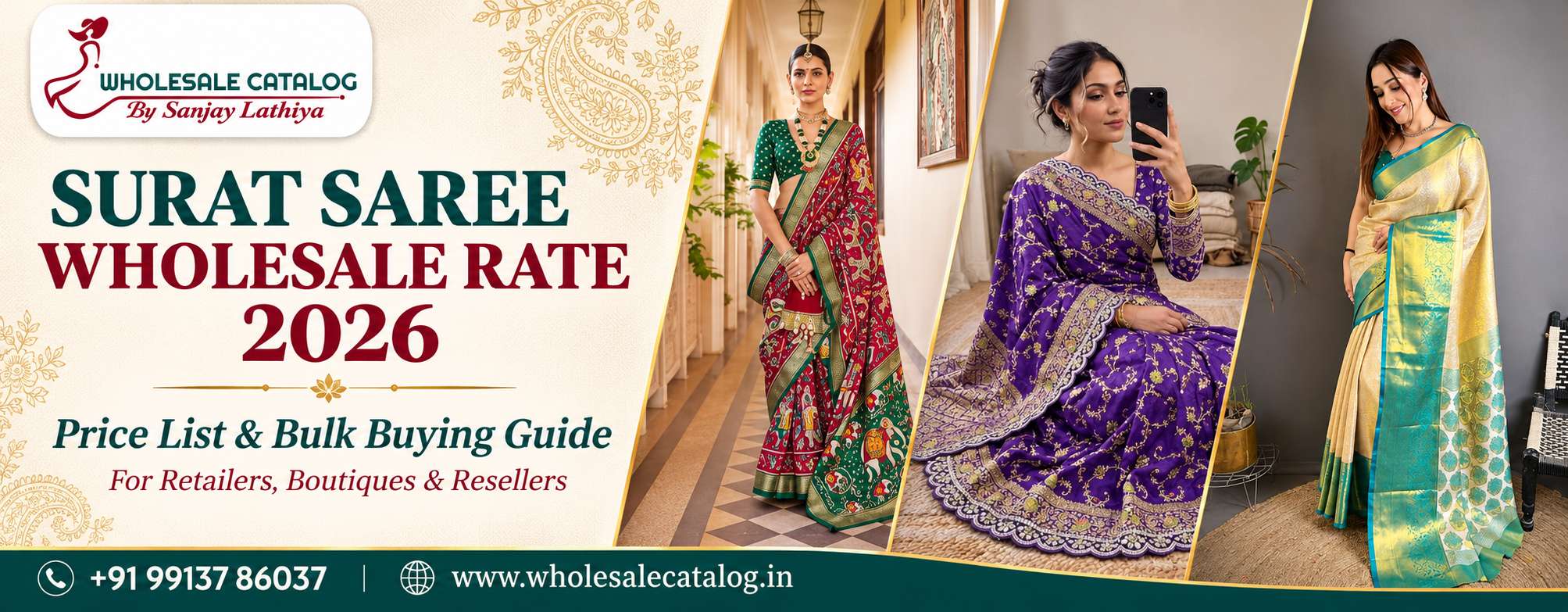
Surat Saree Wholesale Rate 2026: Price List and Bulk Buying Guide
Understanding the Surat saree wholesale rate is one of the most important steps for retailers, boutique owners and resellers planning to purchase sarees in bulk. The price you pay for each saree directly affects your retail margin, inventory investment and ability to compete in your local market.
Surat offers a wide variety of affordable printed sarees, georgette sarees, silk-blend collections, embroidered sarees and premium occasion-wear designs. However, wholesale prices can differ considerably depending on fabric quality, manufacturing technique, catalogue quantity, brand and finishing.
Buying the lowest-priced saree is not always the most profitable decision. A slightly higher-priced collection that sells quickly and generates repeat customers may deliver better business results.
This guide explains indicative wholesale prices, catalogue buying, supplier selection, quality inspection and practical sourcing strategies for Indian and international buyers.
Retailers looking to compare available designs can also browse wholesale saree collections before finalising their purchasing budget.
What Is the Surat Saree Wholesale Rate in 2026?
Surat saree wholesale rates vary according to fabric, design, work, brand and purchase quantity. Basic printed sarees may be available around ₹150–₹400 per piece in selected wholesale collections, while festive and designer varieties can cost ₹1,000 or more. The final purchase rate depends on the specific catalogue, availability, MOQ and additional expenses.
Surat Saree Wholesale Price List – Indicative Rates
| Saree Type | Approximate Wholesale Rate per Piece | Suitable Buyers |
|---|---|---|
| Basic printed sarees | ₹150–₹400 | Budget retailers |
| Daily-wear georgette sarees | ₹180–₹700 | Retailers and resellers |
| Chiffon sarees | ₹225–₹1,000 | Daily and occasion-wear sellers |
| Cotton and cotton-blend sarees | ₹200–₹600 | Boutiques and daily-wear stores |
| Silk-blend sarees | ₹250–₹800 | Mid-range retailers |
| Jacquard sarees | ₹350–₹1,200 | Festive-wear stores |
| Designer printed sarees | ₹250–₹2,000 | Fashion boutiques |
| Fancy embroidery sarees | ₹400–₹1,500 | Occasion-wear retailers |
| Premium festive sarees | ₹1,000–₹2,500+ | Premium boutiques |
These are indicative planning ranges based on publicly advertised wholesale offers and market references, not fixed WholesaleCatalog.in quotations. Product availability, quantities and specifications vary considerably. Confirm live rates and whether GST, packing and freight are included before purchasing.
For accurate quotations, check the latest saree catalogues and prices rather than relying exclusively on a general market price list.
Why Retailers Source Wholesale Sarees from Surat
Surat is an important Indian textile manufacturing and trading centre, particularly for synthetic fabrics, machine-produced sarees, printed textiles, embroidery and contemporary fashion collections.
The availability of manufacturers, fabric processors, traders and catalogue distributors gives buyers access to different designs and price segments.
One practical advantage of sourcing from Surat is the ability to build a mixed collection for different customers. A retailer can purchase affordable daily-wear products alongside festive and premium collections instead of investing the entire budget in one product segment.
Surat is particularly relevant for businesses that regularly introduce new designs through WhatsApp, Instagram, Facebook and physical retail stores.
However, sourcing successfully depends on selecting products that suit the buyer's actual customer base rather than purchasing every newly launched catalogue.
Popular Types of Wholesale Sarees Available in Surat
Different saree varieties serve different commercial purposes. Understanding these differences helps retailers allocate their purchasing budget more effectively.
Printed and Daily-Wear Sarees
Printed sarees are suitable for businesses serving customers who prefer affordable, practical clothing.
When comparing printed collections, inspect fabric thickness, print clarity, softness and colour consistency. These products can support regular sales, particularly when the selling price matches local customer expectations.
Georgette and Chiffon Sarees
Georgette and chiffon sarees appeal to buyers looking for lightweight products with a flowing drape.
They are suitable for fashion retailers, online sellers and boutiques. Buyers should verify the actual fabric composition because a commercial fabric name does not necessarily indicate whether the material is natural or synthetic.
Transparency, fabric finish and blouse-piece quality are also important considerations.
Silk-Blend and Jacquard Sarees
Silk-blend, art silk and jacquard collections can help retailers offer festive-looking products across different budgets.
Examine the weaving finish, zari quality, border alignment and pallu design. Never market an art silk or silk-blend saree as pure silk without proper confirmation.
Designer and Embroidery Sarees
Designer collections can support higher selling prices when the work and finish justify them.
Check for loose threads, damaged embellishments, excessive work weight and uneven embroidery. Premium packaging may also influence whether the product is suitable for gifting or boutique retail.
What Determines the Wholesale Price of a Saree?
Two sarees that appear similar in catalogue photographs may have very different production costs.
The main factors affecting wholesale prices include:
| Pricing Factor | Commercial Impact |
|---|---|
| Fabric composition | Natural fibres, blends and synthetics have different costs |
| Printing technique | Print detail and production method affect pricing |
| Embroidery and zari work | Additional decoration may increase manufacturing costs |
| Order quantity | Larger orders may qualify for different rates |
| Brand | Branded catalogues may carry a price premium |
| Finishing | Better edges, borders and workmanship add value |
| Packaging | Individual boxes or premium packing increase costs |
| Seasonal demand | Availability and quotations may change during peak periods |
Before comparing two suppliers, request matching specifications. A cheaper saree with inferior fabric or a missing blouse piece may not offer better value.
Also confirm whether the displayed amount represents a per-piece rate, a complete catalogue price or a quantity-dependent offer.
Understanding MOQ and Saree Catalogue Buying
In the Surat wholesale saree market, many collections are sold as complete catalogues rather than individual pieces.
MOQ means minimum order quantity. It represents the smallest quantity a supplier accepts for a particular product or catalogue.
A catalogue may contain six, eight, twelve or another specified number of designs. The exact requirement depends on the collection.
For example, suppose a catalogue contains eight sarees priced at ₹450 each.
| Particular | Amount |
|---|---|
| Wholesale rate per saree | ₹450 |
| Catalogue quantity | 8 pieces |
| Total catalogue product value | ₹3,600 |
GST, packing and delivery charges, where applicable, must be considered separately.
Catalogue buying offers coordinated variety, but retailers should inspect all designs in the set. A catalogue containing two excellent designs and six difficult-to-sell designs can create unnecessary stock problems.
New resellers should begin with manageable quantities and increase purchases after identifying customer preferences.
How to Calculate Landed Cost and Retail Margin
The supplier's wholesale quotation is not necessarily your final inventory cost.
Landed cost includes the expenses required to bring the merchandise to your store or warehouse. It is the amount you should consider when determining your selling price.
Example of a Saree Resale Calculation
| Particular | Cost per Saree |
|---|---|
| Wholesale purchase price | ₹400 |
| Allocated packing and delivery | ₹45 |
| Other allocated purchase expenses | ₹15 |
| Non-recoverable taxes, if applicable | ₹20 |
| Total landed cost | ₹480 |
| Suggested selling price for this example | ₹799 |
| Gross profit per saree | ₹319 |
| Gross profit margin | 39.92% |
Illustrative calculation only. Actual selling prices, tax treatment and business expenses will vary.
The gross profit margin is calculated on the selling price. It excludes ongoing expenses such as shop rent, advertising, salaries, payment fees and customer returns.
Online retailers must also account for marketplace commissions, customer delivery costs, promotional discounts and potential returns.
A product with a reasonable margin and consistent demand may be more profitable than an expensive design that remains unsold for several months.
How Different Buyers Should Plan Their Saree Purchases
Every clothing business has different inventory requirements.
| Buyer Type | Recommended Buying Approach |
|---|---|
| New clothing business | Start with a few manageable catalogues and test demand |
| Home-based reseller | Select affordable, visually appealing products |
| Boutique owner | Prioritise finishing, distinctive designs and product presentation |
| Established retailer | Maintain a combination of regular-selling and premium products |
| Semi-wholesaler | Focus on repeat availability and quantity-based quotations |
| Online seller | Check photography suitability, packaging and return risk |
| International importer | Prioritise consistent quality, documentation and landed cost |
Before ordering, decide your expected retail price range. Working backwards from the selling price can help you identify an appropriate purchasing budget and avoid buying products that are unsuitable for your market.
How to Select Reliable Saree Suppliers in Surat
Selecting the right supplier is as important as finding a competitive wholesale rate.
A dependable supplier should provide clear product specifications, accurate catalogue information, transparent payment terms and reasonable communication about stock availability.
Questions to Ask Before Placing a Wholesale Order
- What is the actual fabric composition?
- Does the saree include a blouse piece?
- Are all catalogue designs currently available?
- What is the minimum order quantity?
- Does the rate include taxes and packaging?
- Can popular designs be reordered?
- What is the expected dispatch time?
- What is the procedure for damaged or defective products?
For a new supplier, place a sample or smaller permitted order where practical. Evaluate the merchandise and communication before increasing your order value.
Do not select a supplier solely because they offer the lowest quotation. Delivery delays, incorrect products and inconsistent quality can reduce the profitability of an otherwise attractive purchase.
Best Surat Saree Wholesale Market Sourcing Options
Retailers generally have two options when buying sarees from Surat: visiting physical textile markets or sourcing through online wholesale platforms.
The Ring Road textile trading area is a familiar sourcing location for buyers visiting Surat.
Online vs Offline Wholesale Saree Buying
| Factor | Physical Market | Online Wholesale Buying |
|---|---|---|
| Product inspection | Direct physical examination | Images, videos or samples |
| Travel expenses | Required for outstation buyers | Generally avoided |
| Price comparison | Shop-by-shop enquiries | Catalogue comparison |
| Repeat orders | Depends on supplier communication | Can be managed remotely |
| Suitable for | Buyers visiting Surat | Domestic and overseas buyers |
Surat is not the only worthwhile sourcing destination. Retailers specialising in Bengal cotton, Tant or other regional products should also explore the wholesale saree market in Kolkata.
Combining collections from different textile regions can help a business create a more distinctive inventory.
Saree Quality Checklist Before Buying in Bulk
Product photography is useful for shortlisting designs, but photographs alone cannot establish fabric quality.
Before placing a substantial bulk order, request additional product information or inspect a sample wherever available.
Check the following:
- Fabric texture, softness and drape.
- Saree length, width and blouse-piece availability.
- Printing consistency and visible colour defects.
- Border alignment and pallu workmanship.
- Embroidery finishing and loose embellishments.
- Fabric transparency and colourfastness.
- Stitching quality and sizing for ready-to-wear sarees.
- Packaging condition and accuracy of catalogue labels.
For online orders, confirm the damage-reporting procedure in advance. Recording a continuous unboxing video from the sealed parcel can help document discrepancies or visible defects.
How to Reduce Dead-Stock Risk When Buying Wholesale Sarees
Dead stock is inventory that remains unsold for an extended period. It occupies storage space and blocks working capital that could otherwise be used for new collections.
Instead of purchasing several catalogues simply because their rates are attractive, divide your purchasing budget according to demand.
Example Inventory Allocation Strategy
| Product Segment | Example Budget Allocation |
|---|---|
| Regular-selling daily-wear sarees | 50% |
| Mid-range fashion collections | 30% |
| Festive and premium sarees | 20% |
This is a starting example, not a fixed rule. Adjust the allocation using your sales records and local customer preferences.
Plan festive purchases around relevant occasions such as Navratri, Diwali, Durga Puja, Eid and the wedding season. Overseas retailers should consider their local event calendars and allow sufficient time for international shipping.
Most importantly, track which designs sell quickly and which products remain unsold. Use this information when discussing your next order with suppliers.
Wholesale Sarees from Surat for International Buyers
Indian sarees can serve ethnic clothing businesses catering to customers in the USA, UK, Canada, Australia, UAE, New Zealand, Singapore, Malaysia and Mauritius.
International buyers must consider more than the Surat saree wholesale rate. Freight, import charges and currency conversion can significantly change the final cost.
Lightweight collections may offer shipping advantages, while heavy embroidery and premium packaging can increase parcel weight.
Before confirming an international order, discuss:
- Minimum quantities and catalogue availability.
- Fabric details and consistent product specifications.
- Commercial invoice and shipment documentation.
- Prepaid payment arrangements.
- Actual and volumetric shipping weight.
- Courier or freight options.
- Estimated delivery timelines.
- Destination-specific import duties and taxes.
A smaller trial order, when available, can help overseas businesses evaluate quality and demand before making larger investments.
Import regulations and charges differ by destination. Buyers should confirm applicable requirements with their local customs authority or authorised customs broker.
Common Mistakes to Avoid When Buying Surat Sarees in Bulk
Many wholesale purchasing problems arise because buyers concentrate on the quoted rate without examining the complete transaction.
Common mistakes include:
- Ordering without checking the entire catalogue.
- Comparing prices without matching fabric specifications.
- Purchasing excessive quantities of untested designs.
- Ignoring freight and other landed-cost expenses.
- Assuming repeat stock will always be available.
- Misunderstanding damage and replacement policies.
- Buying premium products for a customer base that prefers budget collections.
A commercially sound purchasing decision balances product quality, selling potential, purchase price and inventory risk.
Why Retailers Use WholesaleCatalog.in for Saree Sourcing
WholesaleCatalog.in is a Surat-based B2B wholesale clothing sourcing platform for retailers, boutiques, resellers and international businesses.
The platform provides access to different saree collections, allowing buyers to explore designs, fabrics, brands and available catalogue information before ordering.
Businesses can also explore complementary categories such as kurtis, dress materials, salwar kameez, lehenga choli and artificial jewellery while expanding their ethnic-wear inventory.
Buyers should confirm live prices, MOQ, stock availability, payment arrangements and shipping charges for each order. Domestic partial COD may be available subject to applicable terms, while international orders are prepaid. wholesalecatalog.in
When requesting assistance, share your preferred fabric, budget per saree, required quantity and delivery location. These details make it easier to identify suitable wholesale collections.
Frequently Asked Questions (FAQs)
1. What is the Surat saree wholesale rate in 2026?
Indicative wholesale rates for basic printed sarees may start around ₹150–₹400 per piece in selected collections. Designer, silk-blend and heavily decorated sarees generally cost more. Confirm the current catalogue price and MOQ before ordering.
2. Can I buy wholesale sarees in Surat under ₹200?
Selected basic printed and synthetic sarees may be available below ₹200, particularly for quantity-based purchases. Availability depends on fabric, design, order quantity and supplier terms.
3. What is the minimum order quantity for Surat wholesale sarees?
MOQ depends on the specific product. Many collections are sold as complete catalogues containing multiple designs, while others have different minimum purchase requirements.
4. Where can retailers buy wholesale sarees online from Surat?
Retailers can browse available saree collections on WholesaleCatalog.in and compare product details, catalogue quantity and applicable prices.
5. Is buying sarees directly from manufacturers always cheaper?
Manufacturer-direct sourcing can offer competitive prices, particularly for higher quantities. However, wholesalers may offer more variety, smaller order requirements and easier access to multiple collections. Compare the complete buying terms.
6. How much profit can a retailer make by selling wholesale sarees?
Profit depends on landed cost, selling price, customer demand and operating expenses. Retailers should calculate actual margins rather than relying on a fixed industry profit percentage.
7. How can I check the quality of wholesale sarees before ordering?
Request detailed product videos, fabric specifications or a sample where available. Examine printing, drape, border finish, blouse-piece quality and embroidery workmanship.
8. Can international buyers purchase wholesale sarees from Surat?
Yes. Overseas boutiques, importers and retailers can discuss international wholesale orders with suppliers offering export delivery. Confirm payment terms, freight costs, documentation and destination-specific import charges first.
9. Are shipping charges included in the saree wholesale rate?
Not necessarily. Some quotations cover only the product value. Confirm taxes, packaging, domestic transport or international shipping charges before making payment.
10. Which sarees are suitable for starting a resale business?
Affordable printed sarees, lightweight georgette collections and selected mid-range festive designs can provide a manageable starting assortment. The ideal selection depends on your target customers and budget.
Final Conclusion & B2B CTA
Understanding the Surat saree wholesale rate helps clothing businesses make informed purchasing decisions, but price alone should never determine the entire sourcing strategy.
Compare fabric quality, catalogue quantity, landed cost, supplier reliability and expected resale demand before placing a wholesale order.
A well-planned saree collection can help retailers protect working capital, reduce unsold inventory and build stronger customer relationships.
Looking for Wholesale Sarees from Surat for Your Business?
Explore saree catalogues for retail stores, boutiques, resellers, online businesses and international importers.
- Website: www.WholesaleCatalog.in
- Wholesale Saree Collection: Browse Available Sarees
- Call / WhatsApp: +91 99137 86037
- Location: Surat, Gujarat, India
Contact our team to discuss current wholesale rates, catalogue availability, bulk order requirements and sourcing options for your business.