

Surat vs Banaras Saree Manufacturing: Wholesale Comparison
Surat vs Banaras Saree Manufacturing: Which Is Better for Wholesale Buyers?
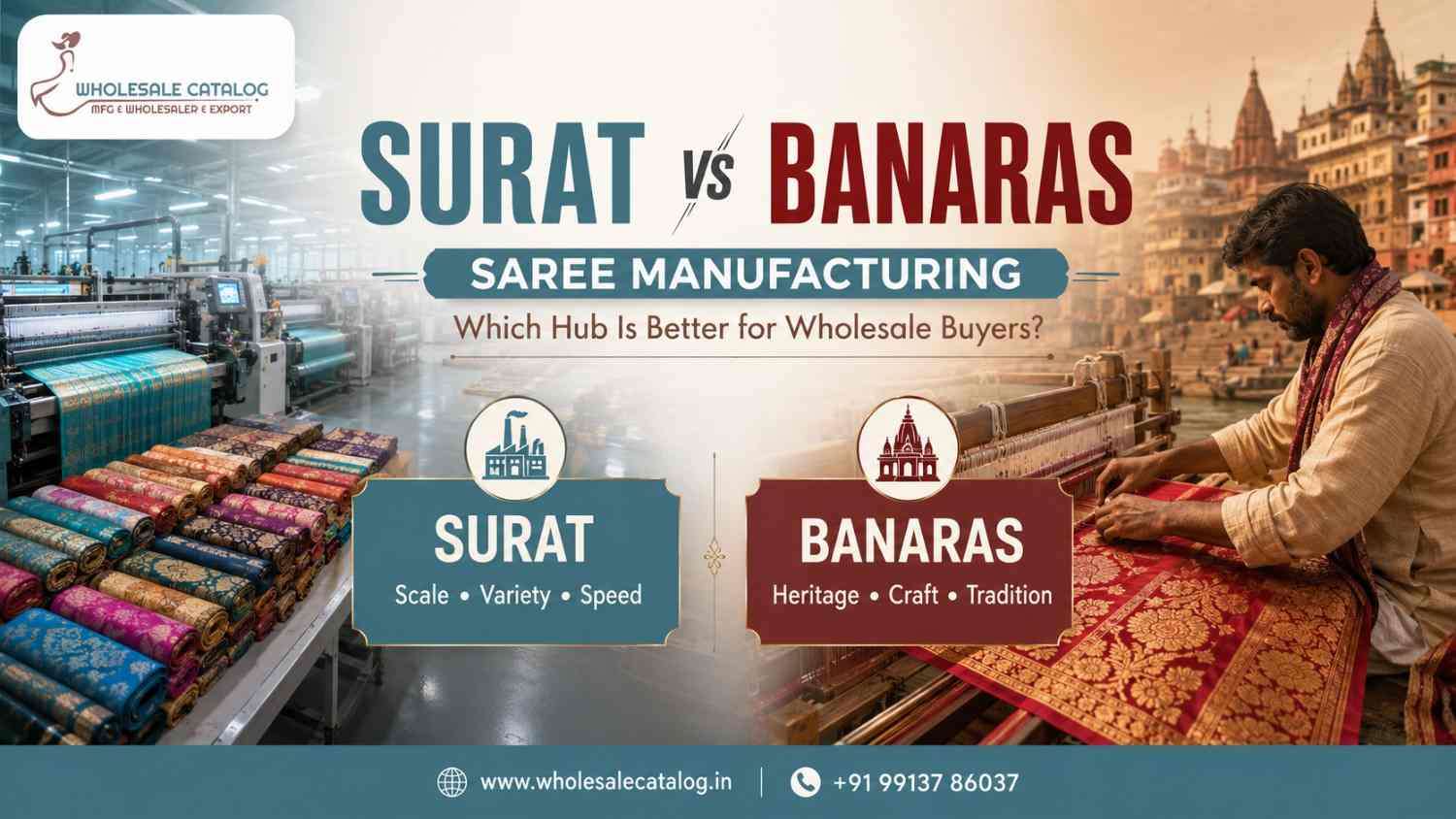
The Surat vs Banaras saree manufacturing comparison is not simply about deciding which city produces better sarees. Both cities have built strong textile identities, but they serve different customers, price segments and business requirements.
Surat is recognised for large-scale textile production, fresh catalogue launches, competitive pricing and a wide range of fabrics. Banaras, also known as Varanasi, is respected for traditional weaving, rich brocade work, cultural value and premium wedding sarees.
For a retailer, boutique owner, reseller or international buyer, the right sourcing destination depends on the target customer, budget, expected profit margin, order quantity and speed of restocking.
This practical guide explains the difference between Surat and Banarasi sarees so that wholesale buyers can build a more profitable and balanced saree collection.
Quick Answer: Surat or Banaras for Wholesale Sarees?
Surat is generally more suitable for retailers who need affordable pricing, fashionable designs, catalogue-based buying and faster restocking. Its textile ecosystem supports everything from budget daily-wear sarees to premium designer collections.
Banaras is more suitable for buyers looking for traditional brocade, heritage-inspired designs, wedding collections and premium sarees with a strong cultural story.
Neither city is an overall winner.
- Choose Surat for variety, volume, faster production and wider price options.
- Choose Banaras for craftsmanship, heritage, premium positioning and wedding demand.
- Choose a combination of both if your customers include value buyers as well as premium shoppers.
Retailers can explore the latest wholesale sarees across different fabrics, budgets and customer segments before deciding their inventory mix.
Understanding Surat Saree Manufacturing
Surat has developed one of India’s most organised and diverse textile ecosystems. The city has a large network of yarn suppliers, weaving units, dyeing and processing houses, embroidery units, designers, manufacturers, wholesalers and transport service providers.
This connected supply chain allows Surat saree manufacturers to introduce new designs at a comparatively fast pace.
Industrial Production and Design Variety
Powerlooms, jacquard machines, digital printing, embroidery technology and modern finishing processes are widely used in Surat. These production facilities allow manufacturers to produce larger quantities while maintaining consistency across a catalogue.
Commonly available Surat sarees include:
- Art silk sarees
- Georgette sarees
- Chiffon sarees
- Crepe sarees
- Jacquard sarees
- Printed sarees
- Embroidered sarees
- Party-wear sarees
- Wedding sarees
- Ready-to-wear sarees
- Banarasi-style sarees
- Designer catalogue sarees
Buyers searching for a reliable Surat sarees wholesale shop usually want access to multiple designs, fresh catalogues and different price levels from one sourcing location.
Why Retailers Prefer Surat
The biggest strength of Surat is flexibility. A budget retailer, Instagram reseller, large showroom and export buyer can all find different product options within the same textile market.
Surat is particularly suitable for businesses that require:
- Competitive wholesale prices
- Multiple designs in one catalogue
- Regular new arrivals
- Faster stock rotation
- Repeatable designs
- Trend-based collections
- Budget, mid-range and premium options
- Bulk production capacity
You can read more about why Surat is India’s saree hub and how its manufacturing ecosystem supports retailers across India and abroad.
Understanding Banaras Saree Manufacturing
Banaras or Varanasi represents a different side of India’s textile industry. Instead of being known mainly for mass fashion production, the city is associated with weaving heritage, brocade patterns, zari work and traditional craftsmanship.
Banarasi sarees have strong demand in the wedding, festive, bridal and premium ethnic-wear markets.
Traditional Weaving and Brocade Work
The Banaras textile cluster produces sarees using handloom as well as powerloom production. Therefore, buyers should not automatically assume that every product sold as a Banarasi saree is handwoven or made from pure silk.
Depending on the collection, Banarasi sarees may be made from:
- Pure Katan silk
- Silk blends
- Kora or organza
- Georgette
- Tissue fabric
- Shattir fabric
- Art silk
- Other blended yarns
Popular Banarasi design styles include jangla, tanchoi, butidar, cutwork, floral jaal, meenakari-inspired patterns and rich zari borders.
The name “Banaras Brocades and Sarees” is officially registered as a Geographical Indication. This makes the geographical origin and correct product description particularly important. Buyers can verify the registration through the official GI Registry of India.
Why Boutiques Prefer Banarasi Sarees
Banarasi sarees offer something beyond fabric and design: they offer a story. Customers often associate them with Indian weddings, family celebrations, traditional functions and heirloom dressing.
Premium boutiques can use this emotional and cultural value to create stronger product positioning. However, the boutique must clearly mention whether a saree is pure silk, silk blend, handloom, powerloom or simply inspired by Banarasi patterns.
Retailers can explore current Banarasi sarees wholesale collections according to their budget and customer profile.
Surat vs Banaras Saree Manufacturing Comparison
The following comparison gives wholesale buyers a clearer understanding of how the two sourcing hubs differ.
| Comparison Point | Surat Saree Manufacturing | Banaras Saree Manufacturing |
|---|---|---|
| Main strength | Scale, variety and speed | Heritage, weaving and craftsmanship |
| Production ecosystem | Industrial and powerloom-dominant | Handloom heritage with handloom and powerloom production |
| Common fabrics | Art silk, georgette, chiffon, crepe and blends | Katan silk, organza, georgette, tissue and silk blends |
| Design approach | Trend-driven and catalogue-based | Traditional brocade and cultural motifs |
| Price positioning | Budget to premium | Mid-range to luxury |
| Restocking | Generally faster for running catalogues | Depends on yarn, weaving and design availability |
| Design variety | Very wide and frequently updated | More focused on traditional and premium styles |
| Best customer segment | Mass retail, online sellers and resellers | Wedding stores, boutiques and premium customers |
| MOQ | Usually catalogue or supplier-based | Depends on manufacturer, wholesaler or weaving unit |
| Customisation | Suitable for bulk and catalogue production | Depends on weaving complexity and order quantity |
| Product story | Fashion, variety and value | Craftsmanship, origin and heritage |
| Export potential | Strong for value and fashion markets | Strong for ethnic, bridal and premium markets |
Major Differences Between Surat and Banarasi Sarees
1. Production Scale
Surat’s manufacturing network is designed to serve a large and fast-moving market. Manufacturers can introduce several catalogues across different fabrics and price ranges within a short period.
Banaras production may require more time, particularly when the saree involves detailed weaving, multiple colours, elaborate brocade or handloom workmanship.
For retailers who need quick stock replenishment, Surat may offer better flexibility. For boutiques that can wait for a carefully selected premium collection, Banaras can create stronger exclusivity.
2. Fabric and Wearing Experience
Surat sarees are available in lightweight as well as heavy fabrics. Georgette, chiffon and art silk collections are popular because they are easy to carry, visually attractive and suitable for a wider price-sensitive audience.
Explore georgette sarees wholesale if your customers prefer lightweight party-wear and festive collections.
Banarasi sarees are usually selected for their woven appearance, rich texture, zari detailing and traditional look. However, the fabric quality can vary significantly. A pure Katan silk saree and an art-silk Banarasi-style saree should not be presented as the same product.
Buyers looking specifically for genuine silk options should study the fabric composition and browse verified pure silk saree wholesale suppliers before ordering.
3. Design and Fashion Cycle
Surat responds quickly to market trends. Celebrity styles, festive colours, wedding-season patterns and social-media-driven designs can enter the wholesale market rapidly.
Banaras designs are generally more rooted in traditional motifs, weaving techniques and cultural preferences. Floral jaal, paisley, butidar patterns, zari borders and elaborate pallus continue to hold long-term value.
Surat is stronger for fast-changing fashion, while Banaras is stronger for designs that remain relevant beyond one season.
4. Wholesale Pricing
Surat generally provides a wider price ladder. A retailer can source budget daily-wear sarees, mid-range festive products and premium designer sarees from the same city.
Banarasi saree prices depend heavily on:
- Type of silk or blended yarn
- Handloom or powerloom production
- Zari quality
- Weaving complexity
- Design exclusivity
- Finishing quality
- Production time
- Manufacturer or artisan involvement
Buyers should never compare two sarees only by their photographs. A low-priced Banarasi-style saree and a handwoven pure silk saree may appear similar in a small image but have completely different manufacturing costs and customer value.
5. MOQ and Restocking
Surat manufacturers commonly work with catalogue-based orders. One catalogue may contain multiple colours or designs, and buyers are generally expected to purchase the complete set or stated MOQ.
Banaras suppliers may offer a complete set, selected pieces or design-based MOQ depending on the collection. Handloom and highly detailed products may not always be available for immediate repeat orders.
Before placing an order, confirm:
- Total pieces in the catalogue
- Number of designs and colours
- Per-piece wholesale price
- Fabric composition
- Blouse-piece details
- Dispatch time
- Repeat availability
- Replacement policy for manufacturing defects
Retailers planning a visit or an online purchase can also explore the best saree wholesale market in Surat before finalising their sourcing method.
Which Manufacturing Hub Is Better for Your Business?
For Budget and Mid-Range Retail Shops
Surat is usually more practical for shops selling affordable daily-wear, festive and occasional sarees. The wider variety makes it easier to serve customers with different budgets.
Fast-moving retailers also benefit from comparatively frequent catalogue updates and easier stock rotation.
For Premium Boutiques
Banaras can be a stronger choice for boutiques that focus on weddings, traditional occasions, premium gifting and heritage fashion.
A boutique can improve the perceived value of the collection by explaining the fabric, weaving method, zari details, design origin and care instructions.
For Online and Social Media Sellers
Online sellers need visually attractive products, clear videos, manageable prices and designs that can generate quick customer interest. Surat’s trend-driven catalogues can be suitable for Instagram, Facebook and WhatsApp selling.
However, Banarasi sarees can also perform well online when sellers use detailed videos, close-up photographs and honest product descriptions.
For International Buyers
Buyers in the USA, UK, UAE, Canada, Australia, New Zealand and other countries should focus on product specifications rather than city name alone.
Before confirming an export order, check:
- Fabric and yarn composition
- Saree length and blouse details
- Actual product video
- Colour variation under different lighting
- Total order weight
- Packing method
- International shipping charges
- Customs requirements in the destination country
- Dispatch and delivery timeline
Shipping charges generally depend on the total parcel weight, destination country and selected courier service.
For New Saree Business Owners
A beginner should avoid investing the entire budget in one expensive category. Start with a balanced collection based on local demand.
For example, a general retail shop may test:
- Affordable Surat sarees for regular sales
- Mid-range festive sarees
- A small premium Banarasi collection
- Selected wedding designs
- A few lightweight sarees for online customers
Read the complete Saree Business in India guide before planning your first wholesale purchase.
How to Identify Banarasi and Banarasi-Style Sarees
One of the biggest market problems is the casual use of the word “Banarasi”. It may refer to the geographical origin, weaving tradition, design pattern or simply the appearance of a saree.
A Surat-manufactured jacquard saree can have beautiful Banarasi-inspired motifs, but it should not be presented as a handwoven pure silk Banarasi saree if it does not meet those specifications.
Wholesale buyers should understand these descriptions:
Pure Banarasi Silk Saree
Ask for details about silk composition, geographical origin, weaving method and available certification or documentation.
Banarasi Silk-Blend Saree
This may combine silk with other yarns. It can offer the richness of a traditional design at a more accessible price.
Banarasi-Style Saree
This generally indicates that the saree uses motifs, borders or brocade patterns inspired by Banaras. It does not automatically confirm Banaras origin, pure silk or handloom production.
Handloom Banarasi Saree
A handloom saree should have clear production information. Buyers should ask for close-up videos, weaving details and supplier documentation instead of relying only on the product title.
Accurate descriptions build customer trust and reduce disputes related to fabric, originality and price expectations.
Should Retailers Source Directly from Surat?
Direct sourcing can help retailers access more collections, understand market pricing and communicate clearly about MOQ. However, visiting multiple manufacturers, checking availability, arranging payments and managing transport can consume considerable time.
Retailers who cannot visit the market can explore direct factory sarees from Surat through an organised wholesale platform.
Always compare the complete landed cost rather than only the per-piece rate. Add packing, transport, payment charges, possible damage risk and unsold inventory before calculating the expected profit.
Final Verdict: Surat vs Banaras Saree Manufacturing
The final decision in the Surat vs Banaras saree manufacturing comparison depends on what your customers want.
Surat is generally the better sourcing choice when your priorities are:
- Competitive wholesale pricing
- Wide design variety
- Faster fashion updates
- Catalogue-based purchasing
- Regular stock rotation
- Budget to premium options
Banaras is generally the better sourcing choice when your priorities are:
- Traditional weaving
- Premium brocade designs
- Wedding and bridal demand
- Cultural and heritage value
- Boutique positioning
- Higher perceived exclusivity
A profitable saree business does not always need to choose one city over the other. A carefully planned combination can serve regular buyers, festive shoppers, wedding customers and premium clients within the same store.
Frequently Asked Questions.
1. What is the main difference between Surat and Banarasi sarees?
Surat is known for large-scale, trend-focused textile manufacturing across multiple fabrics and price ranges. Banarasi sarees are known for brocade work, traditional motifs, weaving heritage and wedding-market demand.
2. Which city is better for wholesale saree buying?
Surat may be better for variety, competitive pricing and faster restocking. Banaras may be better for premium, traditional and heritage-oriented collections. The right choice depends on your target customers.
3. Are Surat-made Banarasi sarees original Banarasi sarees?
A saree manufactured in Surat may use Banarasi-inspired designs, jacquard weaving or brocade patterns. However, it should be described as Banarasi-style unless its geographical origin and product specifications support a different description.
4. Are all Banarasi sarees made from pure silk?
No. Banarasi sarees can be available in pure silk, silk blends, organza, georgette, tissue, art silk and other materials. Buyers should confirm the exact fabric before ordering.
5. Are all Banarasi sarees handwoven?
No. The Banaras textile ecosystem includes both handloom and powerloom production. Ask the supplier to clearly mention the manufacturing method.
6. Which sarees provide a better profit margin?
Profit margin depends on purchase price, customer demand, product quality and selling ability. Surat sarees can support faster volume-based sales, while premium Banarasi sarees may offer higher value per sale when marketed correctly.
7. Can international buyers order Surat and Banarasi sarees?
Yes. International boutiques, resellers and ethnic-wear stores can source both categories. Buyers should confirm MOQ, parcel weight, payment terms, shipping charges and customs requirements before ordering.
8. Where can I buy wholesale sarees online?
Retailers, boutique owners, resellers and international buyers can explore multiple wholesale saree categories on WholesaleCatalog.in. Catalogue and MOQ requirements may vary by product.
Explore Wholesale Sarees for Your Business
Whether you need affordable Surat sarees, fashionable catalogue collections, Banarasi-style designs or premium silk sarees, select products according to your customer profile and selling price.
Explore: Wholesale Sarees Online
Wholesale Enquiry: +91 99137 86037
Website: www.wholesalecatalog.in
Catalogue and MOQ Orders Only | Worldwide Delivery Available