

Wholesale Saree Under 200: B2B Buying Guide 2026
Wholesale Saree Under 200: Practical Buying Guide for Retailers & Resellers

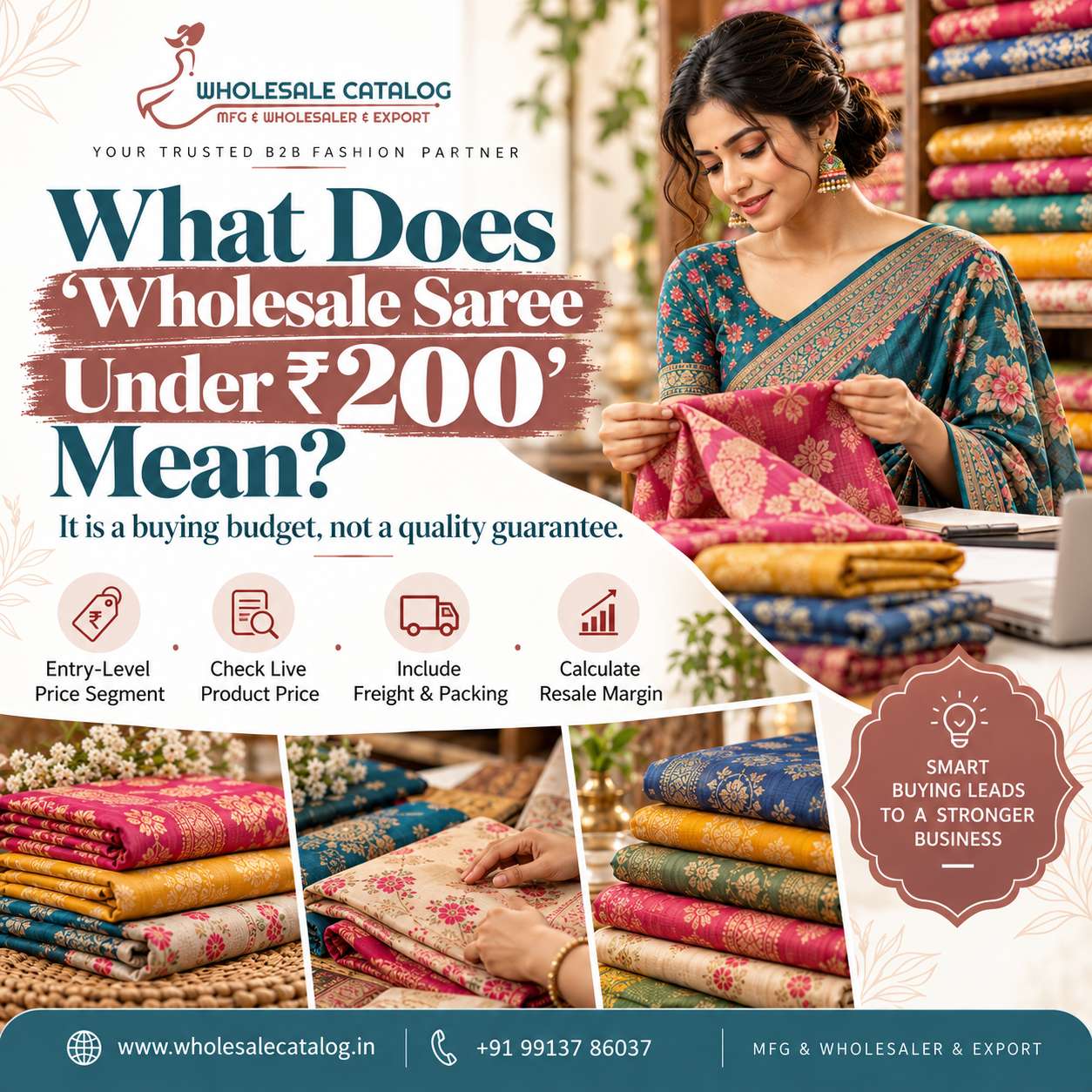
If you are searching for wholesale saree under 200, the real buying question is not simply, “Can I find a saree below ₹200?” The more useful question is: can I source a saree within this purchase budget that offers acceptable quality, attractive presentation and enough resale potential for my market?
For retailers, Instagram sellers, marketplace resellers and new clothing businesses, the sub-₹200 segment can be attractive because it keeps initial inventory investment low. However, fabric, printing, blouse details, catalogue quantity, packing and shipping can significantly influence the final cost.
Before ordering, buyers should therefore compare live products from the wholesale saree collection rather than treating ₹200 as a guaranteed fixed market price.
The objective should be to find commercially sellable stock within your budget, not simply the lowest quotation available.
What Does “Wholesale Saree Under 200” Actually Mean for a B2B Buyer?

A search for sarees below 200 wholesale usually represents a purchasing budget rather than a specific saree category.
A buyer may want the basic product cost to remain below ₹200 per piece so that there is enough room for:
- transportation
- packaging
- marketplace commission
- payment charges
- advertising
- returns or replacement risk
- operating expenses
- reseller margin
However, buyers must distinguish between the quoted saree price and the final landed cost.
For example, a saree may fit your basic buying budget but become more expensive after freight, packing or other applicable costs are included.
This distinction becomes even more important for buyers ordering from another state or importing Indian sarees into the USA, UK, UAE, Canada or Australia.
Featured Snippet Answer: Can You Buy Wholesale Sarees Under ₹200?
Wholesale sarees under ₹200 may be available in selected budget collections, particularly simpler printed, synthetic or daily-wear styles. Availability depends on fabric, design, quantity, supplier rates and current stock. Buyers should confirm the live product price, MOQ, blouse details, packing and shipping cost before calculating their actual resale margin.
Which Types of Sarees Are More Realistic in the Under ₹200 Wholesale Segment?
A ₹200 purchasing ceiling requires realistic product expectations.
Heavy embroidery, premium weaving, elaborate zari work, high-cost natural fibres or premium designer finishing generally involve a different cost structure.
The budget segment is more likely to focus on products where manufacturing and finishing can remain economical.
1. Printed Daily-Wear Sarees
Simple printed sarees are one of the most relevant categories for budget-focused retailers.
They may include floral, geometric, abstract or traditional printed patterns and can appeal to customers buying sarees for routine use.
For resellers, printed sarees also have an advantage: a visually strong print can create good perceived value even when the underlying product belongs to an entry-level price segment.
2. Lightweight Synthetic Sarees
Synthetic and blended fabrics can be important in low-price wholesale sourcing because they can offer colour variety, easy maintenance and scalable production.
Do not market a saree simply as “silk” or another premium fabric because it has a similar shine or appearance. Always verify the actual fabric specification supplied with the product.
3. Simple Casual Sarees
Minimal border designs, basic prints and lightweight fabrics can work well for customers who prioritise affordability over occasion wear.
These products may suit neighbourhood clothing stores, weekly markets, regional resellers, social-commerce sellers and price-sensitive online audiences.
4. Stock-Lot or Special-Price Collections
Sometimes suppliers may offer selected designs or previous catalogue stock at lower rates.
Such opportunities can be attractive, but retailers should check whether:
- all colours are available
- designs can be reordered
- product quality is consistent
- the catalogue is still current
- replacement is possible for genuine defects
A cheap one-time purchase is not automatically better than a slightly higher-priced collection that can be reordered consistently.
Wholesale Saree Under 200 with Price: What Should Buyers Compare?
For a retailer, the purchase price is only one part of the commercial equation.
Use the following framework before comparing two low-price saree catalogues:
| Buying Factor | What to Check |
|---|---|
| Basic product price | Current per-piece or catalogue rate |
| Fabric | Actual fabric or blend specification |
| Print/work | Printing quality, border and decorative work |
| Blouse | Whether blouse piece is included |
| Catalogue quantity | Number of pieces/designs required |
| MOQ | Minimum order applicable to that product |
| Colour mix | Whether all catalogue colours are commercially usable |
| Packing | Individual or catalogue packing details |
| Freight | Cost to your delivery destination |
| Repeat stock | Whether successful designs can be reordered |
| Damage policy | Procedure for genuine manufacturing defects |
| Final landed cost | Total cost before retail selling |
A retailer comparing saree wholesale price under 200 should never compare two products purely from catalogue photographs.
A ₹190 product with weak colour reproduction, inconsistent finishing or an unattractive catalogue mix may create more dead stock than a product costing slightly more but selling faster.
Why Low-Price Sarees Can Work Well for Retailers and Resellers

The main commercial benefit of budget sarees is lower inventory exposure.
Suppose a business has a limited purchasing budget. Investing the entire amount in expensive sarees may allow the retailer to stock only a small number of designs.
A lower-cost segment can provide more variety within the same buying capital.
This is especially useful for:
New Clothing Businesses
New sellers usually have limited data about what their customers will buy.
Instead of predicting demand, they can test several colours, prints and price points with smaller inventory exposure.
Instagram, Facebook and WhatsApp Sellers
Affordable products can generate enquiries from price-conscious audiences, particularly when the photographs clearly show the print, border, pallu and blouse combination.
However, online sellers must include advertising and delivery expenses while calculating their margin.
Meesho, Amazon and Flipkart Sellers
Marketplace sellers should not calculate profit as:
Selling Price – Saree Purchase Price = Profit
Actual margin can be affected by platform charges, logistics, packaging, taxes where applicable, returns and operational expenses.
Always calculate the contribution margin using your current marketplace fee structure.
Physical Retail Stores
Low-price sarees can create an entry-level section for customers who want everyday or frequent-use products.
Retailers can then balance the store with mid-range and premium sarees rather than depending entirely on one price category.
How to Calculate the Real Landed Cost of a ₹200-Budget Saree
Landed cost is one of the most important numbers in wholesale buying.
A simple formula is:
Landed Cost per Saree = Product Cost + Allocated Freight + Packing + Applicable Charges + Other Direct Procurement Costs
If you spend ₹5,000 on goods and ₹500 on transportation, evaluating your margin only on the ₹5,000 product value will give an inaccurate picture.
The transport cost must also be allocated across the pieces purchased.
International buyers need an even broader calculation:
Product Cost + Export Packing + International Freight/Courier + Payment Cost + Destination Duties/Taxes + Local Delivery = Approximate Landed Cost
Import duty and tax rules differ by destination, so importers should verify current requirements locally rather than relying on a general percentage.
For overseas buyers, product weight is particularly important. A few rupees saved at the purchase stage may become irrelevant if a heavier product substantially increases freight.
How Much Retail Margin Should You Keep on Low-Price Sarees?
There is no universal margin percentage suitable for every retailer.
A physical shop, Instagram seller, marketplace seller and overseas boutique can all have very different selling expenses.
Instead of deciding that every saree must be sold at a fixed multiple of its purchase cost, work backwards from the market.
Ask:
What selling price will my customer realistically accept for this product?
Then subtract:
- landed product cost
- marketing expense
- sales-channel costs
- return or damage allowance
- overhead allocation
- desired profit
If insufficient margin remains, the product may not be commercially suitable even if the wholesale price looks attractive.
A profitable product is not necessarily the cheapest product. Sell-through speed and repeat demand matter just as much as the initial buying rate.
How to Check Quality Before Buying Budget Sarees in Bulk
Low purchasing price should not mean accepting an unspecified product.
Before increasing your quantity, inspect or confirm the following.
Fabric Feel and Transparency
Understand whether the fabric is soft, stiff, sheer, heavy or lightweight. These details influence customer expectations.
Printing Quality
Look for clean printing, colour consistency and obvious print defects.
Border and Pallu
A visually attractive border and pallu can significantly improve the perceived retail value of a budget saree.
Blouse Piece
Confirm whether a blouse piece is included and whether it matches or complements the saree.
Finishing
Check edges, loose threads, visible defects and overall presentation.
Colour Accuracy
Online photographs can appear different across lighting conditions and screens. Ask for clear product images or videos where necessary.
For a new supplier or unfamiliar catalogue, a controlled trial order is safer than committing excessive inventory before understanding product quality and customer response.
MOQ vs Full Catalogue: What Low-Budget Buyers Need to Understand

“Wholesale” does not always mean that buyers can select any number of individual pieces.
Some collections may be sold as a full catalogue, while others may follow a specific MOQ.
A catalogue, for example, may contain several colours or designs sold together as one wholesale set.
This creates an important buying question:
Are all pieces in the catalogue suitable for my customers?
If eight designs come in one set but two colours are difficult to sell in your local market, calculate profitability across the full set—not just the six colours you like.
Before placing an order, confirm the applicable quantity requirement on the selected product.
How to Reduce Dead-Stock Risk When Buying Sarees Under ₹200

Low price can encourage overbuying.
Retailers sometimes assume that because each piece is inexpensive, there is little inventory risk. But 100 slow-moving low-price sarees can block more cash than a smaller number of well-selected products.
A safer buying strategy is to divide inventory into three groups:
Proven sellers: colours, fabrics and prints that already sell regularly.
Fresh variations: new designs related to categories that have previously performed well.
Experimental products: small quantities of designs where customer demand is uncertain.
Established retailers should use previous sales records when deciding the proportion.
New businesses can use enquiries, social-media engagement, customer polls and initial trial orders to understand demand before expanding stock.
Surat Wholesale Sarees Under ₹200: How Buyers Should Source
Surat is an important commercial sourcing location for fashion-oriented sarees and textile products.
However, a buyer should not assume that every Surat supplier sells the same product at the same rate or quality.
Compare:
- fabric specification
- catalogue size
- design freshness
- manufacturer or supplier information
- stock availability
- dispatch conditions
- packaging
- freight
- replacement terms
Buyers who do not want to physically visit multiple suppliers can browse wholesale saree collections online and shortlist products according to their price segment and customer profile.
If your store also serves festive or occasion-wear customers, you can compare budget stock with Darbari saree wholesale collections to create a broader good-better-premium assortment.
Under ₹200 Sarees vs Premium Sarees: Which Is Better for Your Business?

Neither segment is automatically better.
The correct choice depends on your customer.
A mass-market reseller may benefit from affordable daily-wear designs, while a premium boutique may find that extremely low-cost sarees do not match its customer expectations.
Many retailers are better served by maintaining several price levels.
Budget Range
Useful for daily wear, entry-level buyers and promotional collections.
Mid-Range
Can offer better fabrics, finishing, designs or occasion versatility.
Premium Range
Relevant for weddings, festivals, gifting and customers who value richer presentation.
Retailers researching different regional sourcing options can also read the Wholesale Saree Market in Kolkata Online guide when comparing product categories and sourcing approaches.
The objective is not to stock every possible price range. It is to build an assortment aligned with your customers.
Online vs Offline Saree Wholesale Buying
Physical textile markets allow buyers to touch fabrics and compare products directly.
Online sourcing offers a different advantage: buyers can review catalogues without travelling every time they need new stock.
For remote retailers and international buyers, this can reduce sourcing friction significantly.
However, online wholesale buying requires disciplined verification.
Before payment, confirm:
- exact product or catalogue
- fabric description
- price
- MOQ
- stock
- dispatch details
- delivery charges
- payment terms
- defect/replacement process
Keep order confirmations and product details recorded for business reference.
Wholesale Sarees Under ₹200 for International Buyers
For an overseas boutique, a saree costing below ₹200 at source does not mean the final landed product will remain below ₹200.
International freight can materially change the economics.
Buyers in the USA, UK, Canada, Australia, UAE, New Zealand, Singapore, Malaysia and Mauritius should evaluate the complete shipment.
A sensible first order focuses on products that:
- fit the local Indian-community demand
- photograph well for online promotion
- are light enough for practical freight economics
- have understandable fabric specifications
- fit the boutique's expected selling price
For a new supplier relationship, starting with a commercially manageable quantity can help evaluate quality, packing, communication and delivery performance before placing larger repeat orders.
Import duties and local taxes are destination-dependent and should be confirmed according to the rules applicable in the buyer's country.
10 Questions to Ask Before Ordering Wholesale Sarees Below ₹200
Before making a bulk purchase, ask:
- What is the current wholesale price?
- Is the price per piece or for a complete catalogue?
- What is the fabric composition?
- Is a blouse piece included?
- What is the applicable MOQ?
- Can the same catalogue be reordered later?
- Are all catalogue colours currently available?
- What are the packing and shipping charges?
- What happens if a product arrives with a genuine manufacturing defect?
- What will be my final landed cost per saree?
These ten questions can prevent many mistakes caused by purchasing solely on catalogue appearance or headline price.
Why Retailers Use WholesaleCatalog.in for Saree Sourcing
.jpeg)
For buyers comparing multiple saree designs, WholesaleCatalog.in provides a B2B-focused way to explore wholesale collections online.
Retailers, boutique owners, resellers, semi-wholesalers and overseas buyers can review available saree catalogues and shortlist products based on the customer segment they serve.
For a search such as wholesale saree under 200, the most practical approach is to check currently available products, verify their live price and MOQ, and then calculate whether the complete landed cost fits your business model.
The same principle applies at every price level: buy according to sell-through potential, not simply the lowest supplier quotation.
Wholesale Saree Under 200: Final Buying Checklist
Before confirming your next order, make sure you know:
- your maximum landed-cost target
- expected retail selling price
- customer type
- fabric specification
- catalogue quantity or MOQ
- best-selling colours
- freight cost
- product weight for export orders
- replacement conditions
- expected margin
- repeat availability
If these points are clear, a low-price saree collection can become part of a controlled inventory strategy instead of a speculative purchase.
Frequently Asked Questions.
1. Where can I buy wholesale saree under 200 online?
You can explore current saree catalogues on WholesaleCatalog.in and compare the live product price, fabric, designs and MOQ. Availability of sarees below ₹200 can change, so confirm the selected product's current price and stock before ordering.
2. Are wholesale sarees below ₹200 suitable for reselling?
They can be suitable for daily-wear, value-focused and price-sensitive customer segments if the fabric, print and finishing meet your customers' expectations. Calculate the full landed cost before deciding your resale price.
3. What type of saree can I expect under ₹200 wholesale?
The budget is generally more realistic for selected simple printed, lightweight synthetic or basic daily-wear sarees than for heavily embroidered, premium silk or elaborate wedding collections. Actual availability varies by supplier and catalogue.
4. What is the MOQ for wholesale sarees under ₹200?
There is no single MOQ for every saree. Some products may require catalogue-based purchasing while others may have a different minimum quantity. Check the requirement of the specific product before placing the order.
5. How do I check the quality of a cheap wholesale saree?
Verify the fabric, print quality, colour, border, pallu, blouse details and finishing. For an unfamiliar supplier or product, begin with a manageable test quantity where practical before scaling your purchase.
6. Can I buy wholesale sarees under ₹200 from Surat?
Budget saree collections can be sourced through Surat's textile supply network, subject to current products and supplier rates. Compare live listings rather than assuming every Surat wholesaler has the same price or quality.
7. Can I sell low-price wholesale sarees on Meesho, Amazon or Flipkart?
Yes, provided the product and your seller account comply with the marketplace's requirements. Calculate marketplace charges, shipping, packaging, returns and advertising costs before deciding the selling price.
8. Do you ship wholesale sarees internationally?
International buyers can make wholesale sourcing enquiries for markets such as the USA, UK, Canada, UAE and Australia. Confirm current product availability, quantity requirements, payment terms and international freight before ordering. Destination duties and taxes depend on local regulations.
9. Is the cheapest wholesale saree always better for resale?
No. A slightly more expensive saree with better colours, photographs, fabric feel and finishing may sell faster and generate a stronger overall return. Inventory rotation should be considered alongside the buying price.
10. How should a new reseller start buying wholesale sarees?
Define your target customer and expected selling price first. Start with a controlled quantity, test several commercially relevant designs and review actual enquiries and sales before investing heavily in one collection.
Looking for Wholesale Sarees for Your Retail or Reselling Business?
Explore current wholesale saree collections and compare designs, fabrics, catalogue quantities and price segments according to your customer market.
For wholesale sourcing, catalogue availability or bulk-order discussion:
WholesaleCatalog.in
Wholesale Enquiry: +91 99137 86037
Retailers • Boutiques • Resellers • Online Sellers • Semi-Wholesalers • Importers • International Buyers