

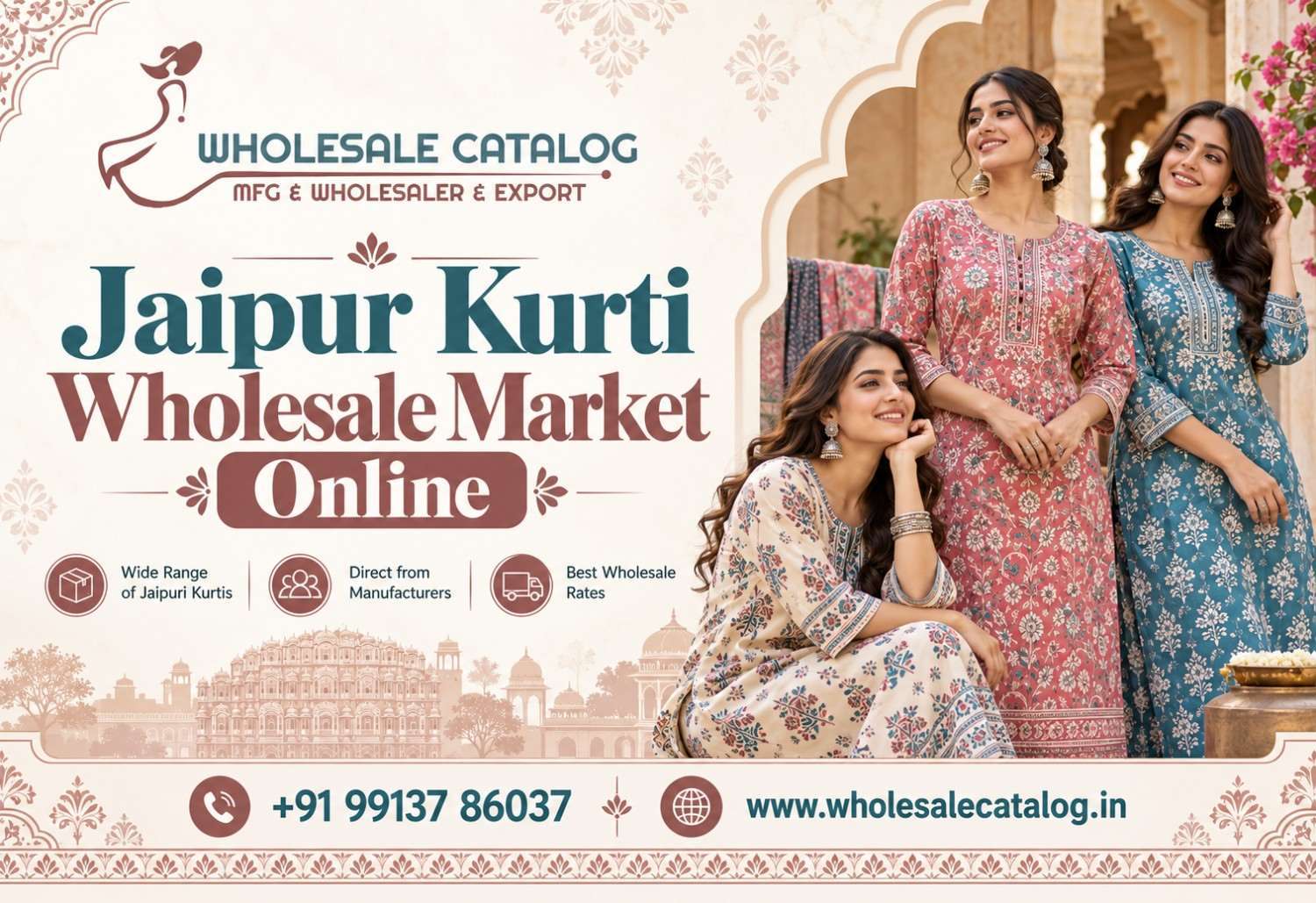
Jaipur Kurti Wholesale Market Online: Retailer Buying Guide
Jaipur Kurti Wholesale Market Online: A Complete Buying Guide for Retailers
Jaipur has an established place in India's textile industry, particularly for printed cotton fabrics, traditional motifs and ethnic clothing. For clothing retailers and boutique owners, Jaipuri kurtis offer a useful combination of regional design identity, everyday wearability and styling variety.
Earlier, sourcing these garments often involved visiting textile markets, comparing samples and meeting wholesalers in person. Today, many buyers prefer reviewing product catalogues online before placing wholesale orders.
The jaipur kurti wholesale market online allows retailers to explore different designs, compare fabrics and understand purchase quantities without depending entirely on physical market visits.
However, successful online sourcing requires more than selecting attractive product photographs. Retailers should understand print techniques, garment construction, sizing, minimum order quantities and actual purchasing costs.
This guide explains how to approach Jaipur-style kurti sourcing online and make better wholesale buying decisions.
Understanding the Jaipur Kurti Wholesale Market
Jaipur's kurti trade is connected to Rajasthan's established textile printing and garment production ecosystem.
Unlike a single shopping complex, the broader Jaipur textile market consists of printing areas, fabric suppliers, garment manufacturers, wholesalers and retail markets.
Different suppliers specialize in different aspects of textile production.
Some produce printed fabrics, while others manufacture finished kurtis, coordinated sets or embroidered garments.
Important Textile Areas in Jaipur
Sanganer: Known for textile printing, particularly detailed floral motifs and traditional printed fabrics. Buyers interested in Sanganeri-style designs often research this production area.
Bagru: Associated with traditional hand block printing, earthy colours, geometric patterns and resist-printing techniques.
Bapu Bazaar: A well-known commercial market where visitors can explore ready-made garments, textiles and traditional Rajasthani products.
For wholesale buyers, the important distinction is whether they are sourcing fabric, finished garments or production services.
A textile printing unit and a finished kurti wholesaler may operate with different prices, order quantities and delivery arrangements.
Why Retailers Are Exploring Jaipur Kurti Wholesale Markets Online
Online sourcing helps retailers compare collections before committing funds to inventory.
1. Access to Multiple Designs
A digital catalogue makes it easier to compare straight-cut kurtis, A-line styles, printed cotton garments and coordinated sets.
Buyers can shortlist designs based on their customers' preferences rather than travelling between different suppliers.
2. Better Inventory Planning
Retailers can review size options, colour combinations and catalogue quantities before finalizing a purchase.
This is particularly useful when planning seasonal collections or replenishing stock.
3. Easier Product Comparison
Online listings help buyers compare fabric descriptions, product photographs, garment lengths and prices.
However, comparisons should include product specifications rather than appearance alone.
4. Convenient Repeat Purchasing
When a retailer identifies a suitable design, a saved product code or catalogue reference can simplify future enquiries.
Repeat availability should always be confirmed because textile collections and production batches can change.
Popular Types of Jaipuri Kurtis Available Online
Understanding the differences between kurti categories helps retailers develop a balanced collection.
Cotton Printed Kurtis
Cotton printed kurtis are commonly associated with comfortable everyday ethnic wear.
They may feature floral prints, small motifs, traditional patterns or contemporary designs.
Retailers should check fabric composition rather than assuming that every product described as a cotton kurti is made from 100% cotton.
Cotton blends and different fabric constructions can affect texture, thickness, shrinkage and garment care.
Sanganeri Print Kurtis
Traditional Sanganeri printing is recognized for delicate floral patterns, fine detailing and nature-inspired motifs.
These designs may include flowers, leaves, vines and small decorative patterns.
An important distinction for buyers is that a Sanganeri-style printed kurti is not necessarily an authentic hand block printed product.
The actual production method should be confirmed with the supplier before advertising a garment as handmade or hand block printed.
Bagru Print Kurtis
Bagru printing has a recognizable visual identity associated with earthy tones and traditional motifs.
Depending on the technique, designs may feature indigo-inspired colours, geometric arrangements and resist-print effects.
Bagru-inspired designs can be suitable for retailers serving customers who prefer understated ethnic clothing.
Buyers should distinguish genuine traditional printing from digitally reproduced patterns.
Rayon Printed Kurtis
Rayon kurtis can provide a softer, more fluid drape than some structured cotton fabrics.
They are available in various printed and ready-made styles.
Retailers should check washing instructions, shrinkage behaviour and fabric thickness because these characteristics depend on the actual textile used.
Kurti Pant Sets
Coordinated kurti and pant sets are another category worth considering.
These garments are purchased as matching outfits, making them relevant for office wear, casual outings and everyday ethnic styling.
When sourcing sets, verify whether the advertised price includes the kurti and bottom together.
If a dupatta appears in the photographs, confirm whether it is included in the actual package.
How to Buy Jaipuri Kurtis Wholesale Online
A structured purchasing process can reduce mistakes and make stock planning more predictable.
Step 1: Identify Your Customer Segment
Begin by identifying who purchases kurtis from your store.
A college-wear retailer may prioritize short kurtis, lightweight fabrics and modern prints.
An everyday ethnic wear store may prefer straight-cut cotton kurtis and comfortable silhouettes.
A boutique selling coordinated clothing may focus more on kurti pant sets and distinctive designs.
Product selection should follow customer demand rather than whichever catalogue contains the largest number of styles.
Step 2: Examine Product Specifications
Before selecting a catalogue, review:
- Fabric composition and material description
- Available sizes and measurement charts
- Kurti length and garment silhouette
- Sleeve and neckline details
- Printed, embroidered or other decorative work
- Included garment pieces
- Available colours and design variations
Product photographs are helpful, but written specifications are essential when assessing wholesale stock.
Step 3: Check Minimum Order Quantity
Minimum order quantity, or MOQ, is the smallest quantity a supplier requires for a particular purchase.
A catalogue may require a fixed number of pieces, while another may have different requirements depending on the design and size assortment.
For example, a catalogue could require 8 pieces, while another requires 12 pieces.
These are illustrative quantities, not universal Jaipur market rules.
Confirm whether the MOQ applies per design, per catalogue, per size assortment or to the overall order.
Also ask whether mixed-size or mixed-colour purchases are permitted.
Step 4: Compare the Total Purchasing Cost
The displayed garment price is only one part of the buying decision.
Retailers should calculate:
Total Landed Cost = Product Cost + Applicable Taxes + Shipping + Other Direct Purchase Expenses
If any taxes or fees are already included, they should not be counted twice.
For example, two suppliers may quote different garment prices but become comparable after shipping and quantity requirements are considered.
The most useful comparison is the final cost of inventory delivered to your business.
Step 5: Confirm Availability Before Payment
Online product listings may remain visible even when certain sizes or colours are unavailable.
Before placing an order, confirm the current stock position, final price, dispatch estimate and complete catalogue quantity.
Written confirmation can help avoid confusion when a design changes or a particular size is unavailable.
Jaipur Kurti Wholesale Pricing: What Determines the Rate?
There is no single wholesale price that applies to every Jaipuri kurti.
Prices vary according to several product and supply factors.
Fabric and Material
Different cotton constructions, rayon fabrics and blended textiles have different production costs.
Fabric quality should be assessed through composition, feel, thickness and suitability for the intended use.
Printing Method
Hand block printing, screen printing and digital printing involve different production processes.
Authentic handcraft techniques should not be confused with mass-produced prints that imitate their appearance.
The method used may influence production time, consistency and cost.
Stitching and Finishing
Garment construction also affects pricing.
Important details include stitching strength, seam alignment, neckline finishing, side openings and overall measurement consistency.
A visually attractive kurti with poor stitching can create problems after it reaches the customer.
Order Volume
Quantity can influence pricing, but larger orders also increase inventory exposure.
A lower per-piece rate does not automatically make a large purchase more profitable.
Retailers should compare expected sales demand with the quantity being purchased.
How to Check Jaipuri Kurti Quality Before Bulk Buying
Online wholesale purchasing requires careful product verification.
Fabric Quality
Request the exact fabric composition and available care information.
Ask about shrinkage and colour-fastness testing, particularly when ordering darker printed fabrics.
Where practical, examine an approved sample before committing to a large purchase.
Print Quality
Inspect whether printed patterns are clear and consistent with the product description.
Small irregularities can be normal in genuine hand block printing, but severe defects and misprints should be assessed separately.
Do not rely on print irregularities alone to establish authenticity.
Size Accuracy
Measurements such as chest width, garment length, shoulder width and sleeve length should be checked against the supplier's size chart.
A size label alone is not enough because garment measurements can vary between manufacturers.
Stitching and Finishing
Check seams, thread finishing, buttons, neckline construction and bottom hems.
For coordinated sets, examine both garments rather than checking only the kurti.
Online vs Offline Jaipur Kurti Wholesale Buying
Both purchasing methods have practical advantages.
Offline sourcing allows buyers to physically inspect fabrics, compare colours and examine stitching before purchasing.
It can be useful for retailers developing a new supplier relationship or evaluating unfamiliar products.
Online sourcing allows buyers to compare catalogues remotely, request product information and place repeat orders without travelling.
However, online buyers depend more heavily on reliable photographs, accurate specifications and supplier communication.
A balanced approach is to evaluate unfamiliar designs carefully and maintain records of products that have performed well in previous orders.
Common Mistakes Retailers Should Avoid
Buying Only Because the Price Is Low
A low purchase rate may be attractive, but fabric, stitching, size consistency and customer suitability matter equally.
Ignoring Catalogue Quantities
Some catalogues require buyers to purchase a defined assortment rather than selecting individual pieces.
Always check the applicable MOQ.
Confusing Style With Place of Manufacture
A kurti advertised as Jaipuri-style may use Rajasthani-inspired designs without necessarily being manufactured in Jaipur.
Retailers should verify origin if they intend to make geographic or craft-authenticity claims.
Purchasing Too Many Similar Prints
A collection containing numerous designs with similar colours and motifs may limit customer choice.
Consider variety in silhouettes, price levels, colours and use occasions.
Overlooking Product Documentation
Maintain records of product codes, specifications, supplier confirmations and invoices.
These details support inventory management and make repeat purchasing easier.
Building a Practical Jaipuri Kurti Collection for Your Store
A successful collection does not need to contain every available style.
Instead, retailers can organize their inventory around customer requirements.
For a daily-wear-focused store, printed cotton kurtis and straightforward silhouettes may form the main assortment.
For a boutique, coordinated sets and more distinctive patterns may offer useful variety.
Retailers can also review how different colours, garment lengths and sizing options perform over time.
Sales records help identify which products deserve replenishment and which should be purchased more cautiously.
WholesaleCatalog.in provides an online collection where buyers can review Jaipuri-style kurti catalogues and their listed purchase requirements.
The final choice should always depend on current availability, product specifications and the retailer's actual selling audience.
Frequently Asked Questions.
1. Where can I find the Jaipur kurti wholesale market online?
Retailers can explore online wholesale catalogues featuring Jaipuri-style kurtis, printed garments and kurti sets. Before ordering, verify product specifications, minimum quantities and supplier details.
2. What types of kurtis are associated with Jaipur?
Jaipur is associated with cotton printed kurtis, Sanganeri-style floral prints, Bagru-inspired patterns and traditional Rajasthani textile designs. Finished garments may also include rayon fabrics and coordinated sets.
3. Can I buy Jaipuri kurtis wholesale without visiting Jaipur?
Yes. Online wholesale platforms and suppliers allow buyers to review catalogues and arrange orders remotely, subject to the supplier's delivery and purchasing conditions.
4. What is the minimum order quantity for Jaipuri kurtis?
MOQ varies by supplier and catalogue. Buyers should check whether the required quantity applies to individual designs, complete catalogues or size assortments.
5. Are all Jaipuri printed kurtis handmade?
No. Jaipuri-style patterns can be produced through hand block printing, screen printing or digital printing. The production method must be verified before describing a garment as handmade.
6. Which fabric should retailers choose for daily-wear kurtis?
Cotton and suitable cotton blends can be practical choices for everyday wear. However, suitability depends on comfort, fabric construction, care requirements, climate and customer preferences.
7. How should retailers compare Jaipur kurti wholesale prices online?
Compare fabric specifications, printing methods, garment construction, minimum quantities and total landed costs. Avoid making a purchasing decision based only on the displayed price.
Conclusion
The Jaipur kurti wholesale market offers retailers access to an established textile tradition and a broad range of garment styles.
Online catalogues make it easier to research products, compare designs and plan inventory without relying entirely on physical market visits.
The most important factors remain fabric quality, accurate specifications, suitable order quantities and careful cost calculation.
Retailers who understand these details can make more informed buying decisions and develop collections that match their customers' requirements.
Explore Jaipuri Kurtis Wholesale Online
Browse the available Jaipuri kurti catalogues on WholesaleCatalog.in to review product designs, size details and catalogue purchase quantities.
View Jaipuri Kurtis Wholesale Collection
Confirm current stock, final pricing and ordering conditions before completing your wholesale purchase.