

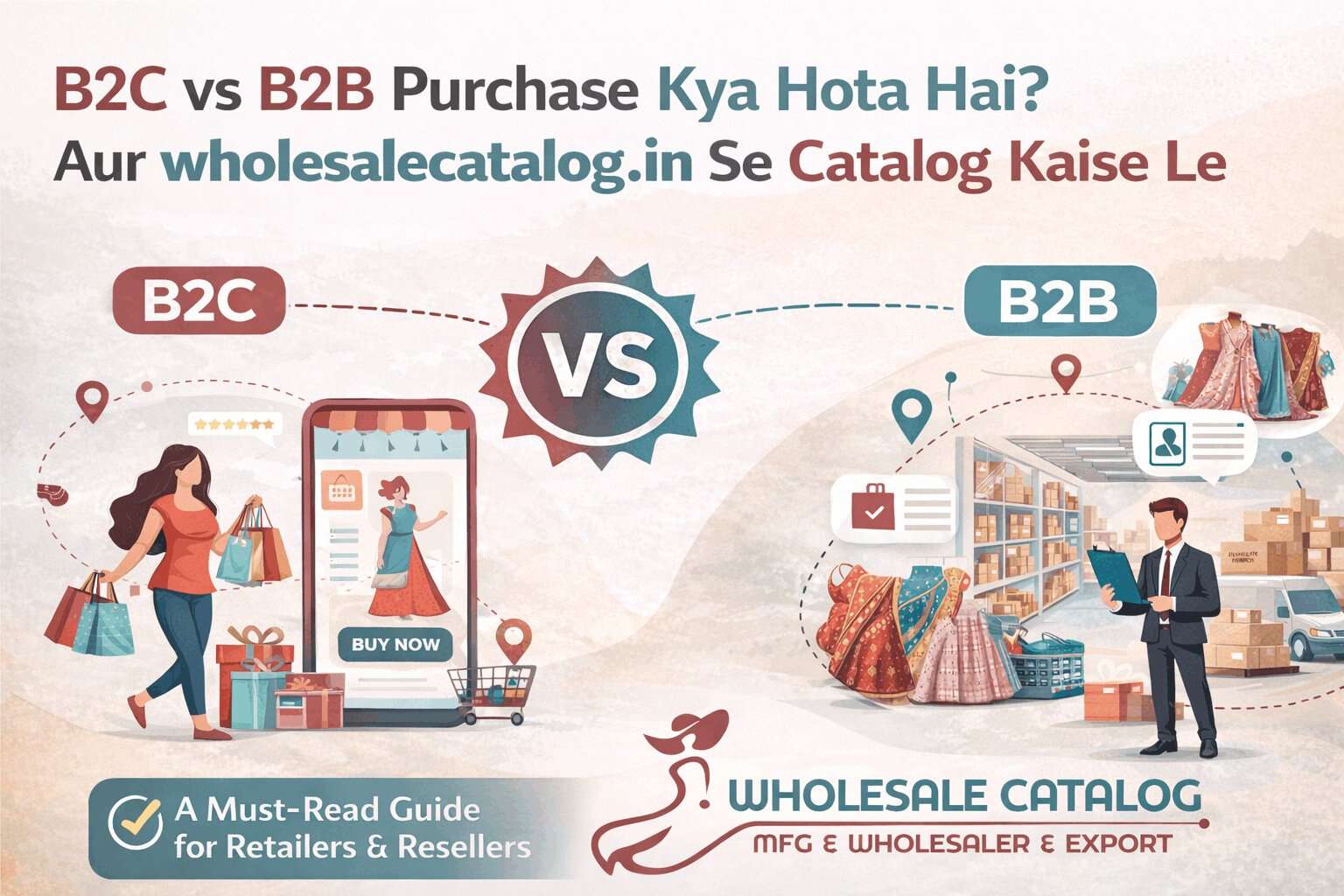
B2C vs B2B Purchase Kya Hota Hai? Aur wholesalecatalog.in Se Catalog Kaise Le
The clothing business has changed dramatically in the last decade. Earlier, most people bought garments from local markets or retail shops. But today, the rise of digital commerce and wholesale platforms has completely transformed how retailers, resellers, and boutique owners source their products. If you are planning to sell Kurtis, Sarees, Dress Materials, Salwar Kameez, Lehenga Choli, or Artificial Jewellery, understanding the difference between B2C and B2B purchase models becomes extremely important.
India’s e-commerce industry is growing rapidly, with the market expected to reach over $345 billion by 2030 due to increasing internet penetration and digital commerce adoption. At the same time, the B2B e-commerce market in India is projected to cross $350 billion by 2027, showing how businesses are increasingly buying products directly from manufacturers and wholesalers through digital platforms.
This growth has opened huge opportunities for retailers, online sellers, and boutique owners who want to build profitable clothing businesses. However, many beginners still get confused about one key question: Should they buy products through B2C or B2B?
In this detailed guide, you will learn:
- What B2C purchase means
- What B2B purchase means
- Which model is best for clothing businesses
- How to get catalogs from wholesalecatalog.in
- Why sourcing from the right wholesale platform matters
Let’s break everything down in simple language.
Understanding Modern Fashion Business in the Digital Era
The clothing industry has always been one of the largest retail sectors in India. From traditional sarees to modern designer outfits, fashion remains an essential part of Indian culture. However, the way clothing businesses operate has evolved rapidly in the digital age. Today, thousands of retailers, resellers, and boutique owners depend on online sourcing platforms instead of visiting physical wholesale markets.
One major reason for this shift is the growth of online B2B marketplaces that connect sellers directly with manufacturers and suppliers. These platforms eliminate the need for middlemen and allow businesses to buy products at wholesale prices. As a result, even small sellers in Tier-2 and Tier-3 cities can access the same products that large retailers sell in metropolitan markets.
For people who want to start a clothing business, understanding sourcing models becomes crucial. If you purchase garments through the wrong model, your profit margins can drop significantly. Many beginners unknowingly buy products through B2C channels, which are designed for personal consumption rather than business reselling.
To build a profitable clothing business, you need to understand how B2C and B2B purchasing models work, and which one is suitable for your goals.
What is B2C (Business to Customer) Purchase
B2C stands for Business to Customer. In this model, a company sells its products directly to the end consumer. The customer buys the product for personal use rather than for resale or profit.
This is the most common model used by retail stores and large e-commerce platforms. When you buy a product from a shopping website, local boutique, or retail shop, you are participating in a B2C transaction.
The B2C model is designed for individual buyers. Products are sold at MRP (Maximum Retail Price), and the quantities are usually small, often limited to single pieces. The focus here is on convenience, variety, and customer experience rather than wholesale pricing.
Key Features of B2C Buying
- Single piece purchase
- Retail or MRP pricing
- Personal use
- Limited profit opportunities
- Short buying process
Because of these characteristics, B2C purchasing is perfect for consumers but not ideal for resellers or boutique owners.
Example of B2C Purchase in Fashion
Imagine a woman buying a kurti from an online store or a local boutique. She selects the design, pays the retail price, and uses the product personally. This transaction is purely a B2C purchase because the product is not meant for resale.
While B2C platforms provide convenience and variety, they are not designed to support businesses that need bulk products or high margins.
What is B2B (Business to Business) Purchase
B2B stands for Business to Business. In this model, one business sells products or services to another business rather than to individual consumers.
This model is widely used in wholesale industries. Retailers, boutique owners, and online sellers purchase products from wholesalers or manufacturers at lower prices so they can resell them to customers with profit margins.
The B2B purchasing process is slightly different from B2C because businesses usually buy products in sets, lots, or bulk quantities. Prices are negotiated based on quantity, and suppliers often provide catalogs containing multiple designs.
Key Features of B2B Buying
- Bulk or set-based purchases
- Wholesale pricing
- Products intended for resale
- Higher profit margins
- Long-term supplier relationships
B2B transactions often involve research and supplier communication, making the buying process more detailed than B2C purchases.
Example of B2B Purchase in Clothing
Suppose a boutique owner wants to sell designer kurtis. Instead of buying one piece from a retail shop, they purchase a full catalog or set of designs from a wholesale supplier. The boutique owner then sells those products to customers at retail prices, earning profit on each piece.
This is exactly how the majority of wholesale clothing businesses operate.
Major Differences Between B2C and B2B Purchase
Understanding the differences between these two models helps you choose the right sourcing strategy.
| Feature | B2C Purchase | B2B Purchase |
|---|---|---|
| Buyer | End customer | Retailer or reseller |
| Quantity | Single piece | Bulk or sets |
| Price | Retail / MRP | Wholesale price |
| Purpose | Personal use | Reselling |
| Profit | No profit | High profit margins |
| Supplier Relationship | Short-term | Long-term business relationship |
This comparison clearly shows why B2B sourcing is essential for anyone planning to sell clothing products.
Why B2B is Important for the Apparel Industry
The fashion industry moves extremely fast. Trends change every season, and customers constantly look for new designs. Retailers who rely on local markets often struggle to keep up with these trends.
Buying through B2B channels solves many of these challenges.
When retailers source garments from wholesale suppliers, they gain access to running catalogs and fresh designs directly from manufacturers. This means they can update their collections quickly and stay competitive in the market.
Another major advantage is pricing. Wholesale suppliers offer products at manufacturer rates, allowing retailers to maintain strong profit margins. In many cases, resellers can earn 30% to 60% profit margins depending on the product category and pricing strategy.
Additionally, B2B platforms provide access to multiple suppliers and product categories in one place. Instead of visiting different markets, retailers can browse catalogs online and connect directly with manufacturers.
This efficiency is one of the main reasons why digital B2B platforms are growing rapidly across India.
What is wholesalecatalog.in
wholesalecatalog.in is a B2B platform designed specifically for retailers, resellers, and boutique owners who want access to wholesale fashion catalogs from Surat manufacturers.
Surat is known as one of In dia’s largest textile hubs, producing a massive variety of garments including kurtis, sarees, dress materials, and ethnic wear. The platform connects these manufacturers with sellers across the country.
On this platform, users can explore:
- Daily new catalogs
- Verified suppliers
- Ready stock updates
- Direct communication through WhatsApp
Instead of visiting the wholesale market physically, retailers can browse designs online and contact suppliers instantly.
Step-by-Step Process to Get Catalog from wholesalecatalog.in
Getting catalogs from the platform is extremely simple. Even beginners who are starting their clothing business can easily follow the process.
Step 1: Visit the Website
Open the website wholesalecatalog.in in your browser.
Step 2: Select Your Category
Choose the category that matches your business:
Step 3: Browse the Catalog
Each catalog contains multiple designs, colors, and product details.
Step 4: Click the WhatsApp Inquiry Button
Once you find a design you like, click the WhatsApp inquiry button to contact the supplier directly.
Step 5: Ask for Price and MOQ
The supplier will provide:
- Wholesale price
- Minimum order quantity
- Dispatch details
There are no brokers or middlemen involved, which makes the process transparent and reliable.
Categories Available on wholesalecatalog.in
The platform offers a wide variety of fashion categories that are popular among retailers and resellers.
Popular Categories
- Designer Kurtis
- Fancy Sarees
- Unstitched Dress Materials
- Readymade Salwar Kameez
- Bridal Lehenga Choli
- Trending Artificial Jewellery
All products are available under the B2B wholesale clothing model, ensuring competitive pricing and strong margins for sellers.
Why WholesaleCatalog is a Trusted Platform
The wholesale textile market in Surat is extremely large, but it also comes with challenges. Many new buyers face issues such as fake agents, duplicate designs, and misleading pricing.
WholesaleCatalog aims to solve these problems by providing a transparent platform where retailers can connect directly with manufacturers.
Key benefits include:
- Verified suppliers
- Running catalogs with real designs
- Direct manufacturer connection
- No middlemen or hidden commissions
For new sellers, this reduces the risk of sourcing products from unreliable sources.
How B2B Purchase Helps Increase Profit
Profit is the backbone of any business. If your sourcing cost is high, your margins will automatically shrink.
When retailers buy garments through B2B wholesale channels, they gain access to manufacturer pricing. This allows them to sell products at retail rates while maintaining healthy profit margins.
For example, if a kurti is purchased at a wholesale price of ₹400 and sold at ₹700, the reseller earns ₹300 profit per piece. Multiply that by dozens of pieces, and the business quickly becomes profitable.
Another advantage is repeat customers. When sellers consistently provide fresh designs and competitive prices, customers are more likely to return.
Perfect Platform for Resellers and Online Sellers
The rise of social commerce has created huge opportunities for resellers. Today, thousands of people sell clothing products through platforms such as:
- Meesho
For these sellers, having access to reliable catalogs is extremely important. WholesaleCatalog allows them to collect product catalogs, share images with customers, and place orders directly with suppliers.
This model makes it possible to start a clothing business even without maintaining physical inventory.
Trusted Suppliers, Latest Designs, Fast Dispatch
One of the biggest concerns for retailers is product reliability. Delayed shipments or poor quality products can damage customer trust.
Suppliers listed on the platform typically maintain:
- Verified product listings
- Ready stock availability
- Fast dispatch systems
- Secure packaging
These factors help retailers run their businesses smoothly without worrying about sourcing issues.
The difference between B2C and B2B purchasing plays a crucial role in building a profitable clothing business. While B2C models are perfect for individual shoppers, they are not suitable for retailers or resellers who want to earn profits.
For anyone working with products like Kurtis, Sarees, Dress Materials, Salwar Kameez, Lehenga Choli, or Artificial Jewellery, the B2B wholesale model is the smartest approach.
Instead of buying products at retail prices, retailers should source garments directly from manufacturers through wholesale platforms. This ensures better pricing, larger product variety, and stronger profit margins.
Platforms like wholesalecatalog.in simplify this process by connecting retailers with verified suppliers and providing easy access to running catalogs.
If you want to grow your clothing business in today’s competitive market, choosing the right sourcing platform can make all the difference.
Customer FAQs
1. What is the main difference between B2B and B2C purchasing?
B2C purchasing involves businesses selling products directly to end consumers for personal use, while B2B purchasing involves businesses buying products from other businesses for resale or operational use.
2. Why should clothing retailers prefer B2B sourcing?
B2B sourcing offers wholesale pricing, larger product variety, and higher profit margins compared to retail purchasing.
3. Is wholesalecatalog.in suitable for new resellers?
Yes, the platform is designed for retailers, boutique owners, and online sellers who want access to wholesale catalogs and verified suppliers.
4. Can I start a clothing business without visiting Surat market?
Yes. Online B2B platforms allow you to browse catalogs, contact suppliers, and place orders without visiting physical wholesale markets.
5. What products can I source from wholesalecatalog.in?
You can source Kurtis, Sarees, Dress Materials, Salwar Kameez, Lehenga Choli, and Artificial Jewellery along with many other fashion categories.