

Indian Wholesale Clothing: Complete Guide for Retailers, Boutiques & Resellers
Indian Wholesale Clothing: A Practical Sourcing Guide for Retailers, Boutiques & Resellers
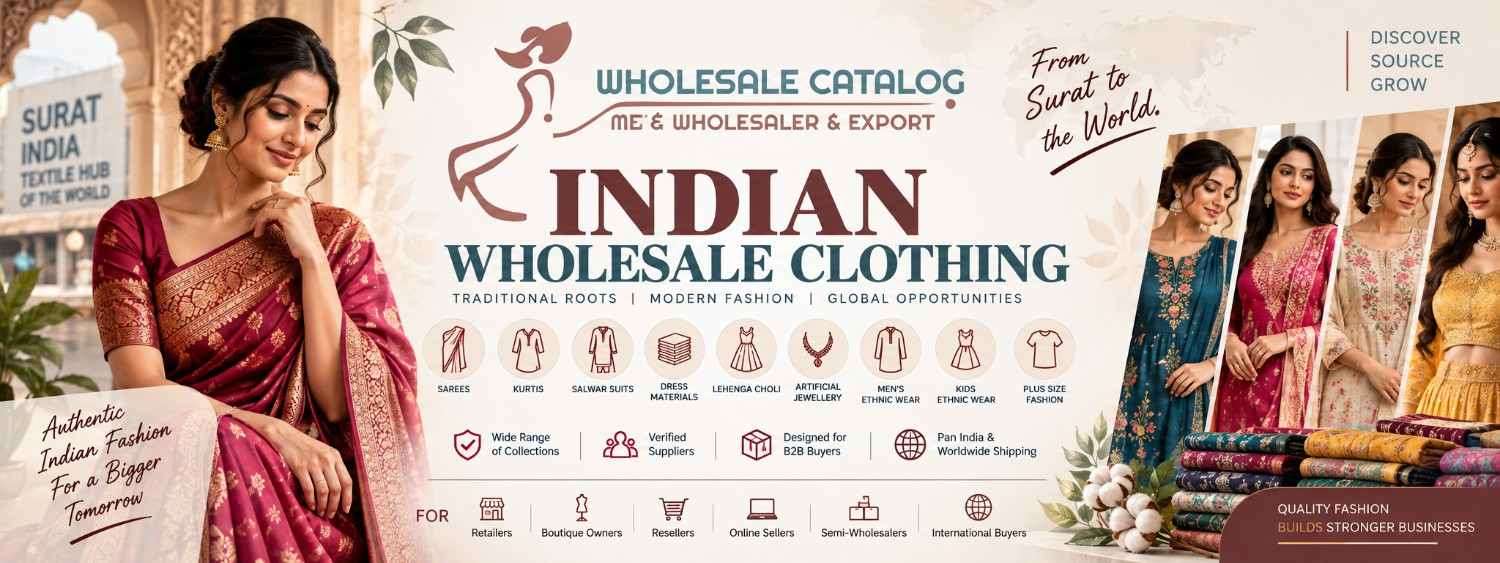
Indian wholesale clothing gives retailers access to something difficult to build from a single local supplier: a broad mix of sarees, kurtis, salwar suits, dress materials, lehengas, festive wear and everyday ethnic fashion across multiple price segments.
But finding products is the easy part.
The bigger challenge is deciding what to buy, how much to buy, which supplier to trust, what quality to expect and whether the final landed cost leaves enough room for profit.
This guide explains how retailers, boutiques, online sellers, resellers and international buyers can approach Indian clothing sourcing as a business decision. You'll learn how to compare suppliers, understand MOQ, select fabrics and sizes, test collections, plan inventory and avoid common wholesale buying mistakes.
What Is Indian Wholesale Clothing?
Indian wholesale clothing refers to apparel purchased in business quantities from Indian manufacturers, wholesalers, distributors or B2B sourcing platforms for resale rather than personal use.
Depending on the supplier, wholesale inventory may be sold as individual pieces, minimum-quantity orders, complete catalogues or design sets containing multiple colours or sizes.
Popular categories include:
- Sarees
- Kurtis and kurta sets
- Salwar suits
- Readymade suits
- Dress materials
- Lehenga choli
- Co-ord sets
- Gowns
- Men's ethnic wear
- Kids' ethnic wear
- Plus-size clothing
- Occasion and festive wear
For a retailer, the goal isn't simply finding the lowest wholesale rate. The right product must combine acceptable landed cost, sellable designs, dependable quality and manageable inventory risk.
Why Buyers Source Wholesale Clothing from India
India's advantage is the depth of its textile and apparel ecosystem.
A buyer can source inexpensive everyday products, mid-market boutique collections and heavily embellished occasion wear from different manufacturing and trading clusters.
For Indian ethnic fashion in particular, buyers can find substantial variety across fabrics, embroidery, printing techniques, silhouettes and regional styles.
This allows retailers to build assortments for very different customers.
A neighbourhood clothing store may concentrate on affordable daily-wear sarees and kurtis, while an overseas boutique may focus on premium sarees, embroidered suits and lehengas.
The sourcing strategy should therefore begin with the customer, not the supplier.
What Indian Clothing Should You Buy Wholesale?
There is no single best wholesale category. Your ideal assortment depends on customer demographics, selling channel, climate, occasion and average selling price.
| Category | Common Retail Opportunity | Buying Consideration |
|---|---|---|
| Sarees | Daily, festive, wedding and occasion wear | Fabric, blouse details, work and regional demand |
| Kurtis | Everyday, office and casual fashion | Sizes, fabric, fit and repeatability |
| Salwar/Readymade Suits | Daily to festive | Complete set contents and sizing |
| Dress Materials | Customers preferring custom stitching | Fabric length, components and colour |
| Lehenga Choli | Wedding and festive market | Work quality, finishing and sizing |
| Co-ord Sets | Contemporary fashion buyers | Fit, fabric and trend lifecycle |
| Plus Size | Specialist and underserved segments | Size consistency and measurements |
| Men's Ethnic Wear | Festivals, weddings and events | Size ratio and seasonal demand |
A retailer should resist the temptation to stock every available category immediately.
A narrower, faster-moving assortment is often easier to manage than a huge catalogue with slow inventory turnover.
Surat's Role in Indian Wholesale Clothing
Surat is especially relevant when sourcing women's ethnic wear and textile-based fashion.
The city's textile ecosystem supports fabrics, sarees, dress materials, kurtis, suits and many other women's fashion categories. Current wholesale suppliers serving both Indian and international buyers continue to operate from Surat and market these categories to retailers, boutiques and resellers.
For buyers, the importance of Surat is not simply that products are "from Surat." It is the concentration of manufacturers, textile businesses, wholesalers, traders and logistics infrastructure around the industry.
That can give buyers access to a large number of collections without building relationships with suppliers scattered across the country.
However, location alone should never be treated as proof of quality.
A Surat supplier should still be evaluated using exactly the same criteria as any other supplier: product accuracy, pricing, MOQ, availability, communication, quality control and order terms.
Manufacturer vs Wholesaler vs B2B Marketplace
Understanding who you are buying from can prevent incorrect expectations.
Manufacturer
A manufacturer produces its own products or collections.
This can provide advantages when you need larger quantities, repeated production or customised manufacturing.
However, manufacturers may specialise in relatively narrow categories.
Wholesaler
A wholesaler can aggregate collections from different manufacturers or brands.
This can be useful when your priority is variety rather than a large quantity of one design.
B2B Marketplace or Sourcing Platform
A wholesale platform can make it easier to browse multiple categories and collections from one place.
For retailers who want sarees, kurtis, suits, dress materials and other products without independently locating a supplier for every category, this model can simplify discovery.
The right option depends on whether your priority is depth, variety, customisation or convenience.
Understanding MOQ Before You Buy
MOQ means Minimum Order Quantity—the smallest quantity a supplier will accept for a wholesale purchase.
Never assume that MOQ means the same thing across suppliers.
It might apply to:
- One design
- One colour
- One size
- A complete catalogue
- One product category
- Total order value
- Total pieces across several products
Suppose you want 30 pieces.
Supplier A may allow six different designs with five pieces each. Supplier B may require all 30 pieces from one collection.
The total quantity is identical, but the inventory risk is completely different.
For a boutique or new reseller, assortment flexibility can sometimes be more valuable than a slightly lower unit price.
Always ask exactly how the MOQ is calculated.
Wholesale Pricing: Don't Compare Product Price Alone
One of the biggest wholesale buying mistakes is comparing two suppliers only by their quoted garment price.
Your useful number is the landed cost.
For domestic orders, this can include:
Product cost + applicable tax + transport + packaging/handling + payment-related costs
For international orders, it can also include:
International freight + duties/taxes + customs clearance/brokerage + local delivery
For example, a cheaper supplier may become more expensive if shipping is significantly higher or if you must purchase more unwanted designs to meet the MOQ.
Your margin should be calculated from the complete cost of getting sellable inventory into your business—not just the supplier's product price.
How to Compare Indian Wholesale Clothing Suppliers
Use the same framework for every supplier rather than judging suppliers by product photos alone.
| Factor | What to Check |
|---|---|
| Product range | Does it match your customer profile? |
| MOQ | Per design, catalogue, size or order? |
| Pricing | What is included in the quoted price? |
| Quality | Fabric, stitching, finishing and work |
| Size information | Measurements or only size labels? |
| Product accuracy | Do actual goods match displayed photos? |
| Availability | Is stock ready or made after ordering? |
| Reordering | Can winning designs be reordered? |
| Dispatch | How quickly is stock normally prepared? |
| Replacement policy | What happens with damage or defects? |
| Communication | Can the supplier clearly answer B2B questions? |
| Export capability | Can international orders and documentation be handled? |
A supplier offering the cheapest piece is not necessarily your cheapest supplier after stock failures, quality issues and unsold inventory are considered.
Before You Place a Wholesale Order
Before transferring money, confirm the commercial terms in writing.
1. Confirm exactly what you are buying
Request the:
- Product code
- Number of pieces
- Colours
- Sizes
- Fabric
- Work/embellishment details
- Included components
For example, if you're purchasing a three-piece suit, confirm exactly what is included rather than assuming from the photograph.
2. Ask whether stock is currently available
Fashion inventory can move quickly.
A product shown in a catalogue may not necessarily remain available when payment is made.
Confirm current stock before completing the transaction.
3. Understand the MOQ
Ask whether you must purchase a full catalogue or whether designs, colours and sizes can be mixed.
4. Confirm dispatch expectations
"Available" and "ready to dispatch" should not automatically be treated as identical.
If you are purchasing for a festival, promotion or customer commitment, timing matters.
5. Understand damage and replacement terms
Ask what evidence is required if the shipment contains:
- A damaged item
- Wrong product
- Missing piece
- Manufacturing defect
Also check the reporting deadline.
Wholesale Clothing Quality Checklist
A professional buyer should inspect more than the front design.
Fabric
Check fabric composition or stated fabric type, thickness, transparency, feel and suitability for your target market.
Stitching
Inspect seams, loose threads, neckline finishing, sleeves, zippers, hooks and stress points.
Embroidery and Decorative Work
Check whether stones, sequins, beads or embroidery are securely attached.
Colour
Online photographs can look different because of lighting, editing and displays.
If exact colour matters, ask the supplier before ordering.
Measurements
Never depend exclusively on labels such as M, L or XL.
For fitted garments, actual garment measurements can be much more useful—particularly for international customers accustomed to different sizing conventions.
Packaging
Products intended for boutique resale or international delivery need packaging capable of surviving transport without unnecessary damage.
Fabric Selection for Wholesale Buyers
Fabric influences far more than appearance.
It affects comfort, price, shipping weight, customer expectations, seasonality and perceived value.
Common fabrics and fabric families found across Indian fashion can include cotton, rayon, georgette, silk and silk-look materials, muslin, chiffon, linen blends, jacquard and other woven or synthetic blends.
Instead of asking only, "Which fabric is best?", ask:
Which fabric fits my customer's use case and price expectation?
For example, lightweight everyday garments and premium occasion wear solve very different customer needs.
International buyers should also consider local climate. A collection suitable for a hot-weather market may require a different fabric mix from one being sold during winter in Canada or the UK.
Inventory Planning: Buy Variety Before Depth
For an untested collection, buying deep inventory can create unnecessary risk.
A practical strategy is:
Test → Measure → Reorder → Scale
Start with enough variety to discover what customers actually respond to.
Track:
- Designs receiving the most enquiries
- Sizes selling first
- Colours that move fastest
- Categories with repeat purchases
- Actual gross margin
- Time required to sell through inventory
Once you identify repeatable winners, increase order depth.
This is particularly important for trend-driven fashion, where a low purchase price does not help if the inventory remains unsold.
Seasonal Buying for Indian Fashion
Wholesale buying should happen before demand peaks—not when customers have already started shopping.
Potential demand periods can include:
- Wedding seasons
- Eid
- Navratri
- Diwali
- Raksha Bandhan
- Regional festivals
- Summer/winter changes
- Overseas South Asian wedding seasons
The exact buying calendar depends on your customer base.
International boutiques should also account for shipping and customs lead time when planning festival inventory.
Don't allocate the entire seasonal budget to one design simply because it looks attractive in a catalogue.
Use a combination of proven products and controlled tests of newer styles.
Online vs Offline Indian Wholesale Sourcing
Both models have advantages.
Offline sourcing
Visiting textile markets allows buyers to physically inspect fabrics, finishing and colours.
It can work particularly well for buyers placing substantial orders or building long-term sourcing relationships.
The disadvantages are travel time, travel cost and the difficulty of visiting repeatedly for every new collection.
Online wholesale sourcing
Online platforms allow retailers to review new collections remotely and source without travelling to a textile hub.
This is particularly useful for buyers outside Surat or international retailers.
But remote buying makes product information and supplier reliability more important.
Before paying online, verify the product, MOQ, availability, shipping and replacement terms rather than making decisions from photographs alone.
Buying Indian Wholesale Clothing for USA, UK, Canada, Australia and UAE
International sourcing requires an additional calculation: landed cost and market suitability.
A collection that sells successfully in India is not automatically right for every overseas market.
International buyers should consider:
Customer profile
Are your customers shopping for daily ethnic wear, weddings, religious events, parties or premium designer-style products?
Sizing
Check garment measurements rather than translating Indian size labels directly into local sizing expectations.
Shipping economics
Low-value bulky products can become unattractive when freight is added.
Compare the selling potential against the complete landed cost.
Import requirements
Customs rules, taxes, duties, labelling requirements and documentation vary by destination and can change.
Verify the current requirements applicable to your country and shipment before importing.
Order timing
Build international shipping and potential clearance delays into your seasonal buying calendar.
Common Mistakes Wholesale Clothing Buyers Make
Buying only because the price is low.
Cheap inventory that doesn't sell is expensive inventory.
Ordering too much of an untested design.
Test customer response before committing substantial capital.
Ignoring size ratios.
A collection can sell well overall while leaving you with unsold sizes.
Not calculating landed cost.
This is especially dangerous for international buyers.
Assuming photos guarantee exact appearance.
Confirm fabric, work, colours and product specifications.
Buying trends too late.
Trend-driven inventory loses value when the market has already moved.
Using one supplier for everything without comparison.
Different suppliers may be stronger in different categories.
Ignoring replacement terms until there is a problem.
Understand the procedure before placing the order.
Questions to Ask an Indian Wholesale Clothing Supplier
Before placing your first substantial order, ask:
- What is the MOQ?
- Does MOQ apply per design or total order?
- Can I mix designs, colours or sizes?
- Is this product currently in stock?
- What fabric is used?
- What are the actual garment measurements?
- What exactly comes in the set?
- What is the expected dispatch time?
- What are the shipping charges?
- What happens if a product arrives damaged or incorrect?
- What proof is required for a replacement claim?
- Can successful products be reordered?
- Do you ship internationally?
- Which payment methods are accepted?
A supplier's ability to answer these questions clearly can itself tell you a lot about how prepared they are to work with professional buyers.
How New Retailers Should Start Buying Wholesale Clothing
If you're starting a boutique, retail shop or online fashion business, don't make your first order unnecessarily complicated.
Start with a defined customer.
For example:
Customer: Women aged 25–45 looking for everyday ethnic wear
Categories: Kurtis + readymade suits
Price positioning: Affordable/mid-market
Initial strategy: Multiple designs, controlled quantities
Goal: Identify repeatable bestsellers before increasing inventory
This is a much stronger sourcing strategy than simply purchasing whatever a wholesaler recommends.
Once you have sales data, expand based on what customers actually buy.
Using WholesaleCatalog.in for Multi-Category Sourcing
Retailers who don't want to independently search for a separate supplier for every product category can use WholesaleCatalog.in to explore multiple wholesale fashion collections from one B2B-focused platform.
Depending on current availability, buyers can explore categories such as:
Wholesale Sarees
For daily wear, festive, wedding and occasion-based saree inventory.
Wholesale Kurtis
For boutiques, retailers and resellers building everyday and fashion-focused ranges.
Wholesale Dress Materials
For customers who prefer customised stitching.
Wholesale Salwar Suits
For stores requiring traditional and readymade ethnic collections.
Wholesale Lehenga Choli
For festive and wedding-focused inventory.
Buyers should still evaluate each collection individually for fabric, sizes, MOQ, price and suitability for their own customers.
The advantage of browsing across categories is that your purchasing decision can be based on your complete inventory requirement rather than a single product type.
Indian Wholesale Clothing Buying Checklist
Before finalising an order, confirm:
- Product/design code
- Current availability
- Fabric
- Colour
- Sizes and measurements
- Quantity
- MOQ structure
- Price
- Applicable taxes
- Shipping charges
- Total landed cost
- Dispatch timeline
- Payment terms
- Damage/replacement process
- Reorder possibility
- International shipping requirements, if applicable
For larger orders, keeping this information in a purchasing sheet makes supplier and collection comparisons much easier.
Final Buying Perspective
Successful wholesale sourcing isn't about finding the largest catalogue or the lowest quoted price.
It is about finding products that match your customers while keeping inventory risk, landed cost and quality problems under control.
For new buyers, smaller tests across multiple relevant designs can provide valuable sales information. Established retailers can use their historical sales data to buy deeper into proven categories, sizes and price ranges.
Whether you source from Surat or another Indian textile centre, the same principle applies:
Buy according to customer demand, verify before ordering, calculate the complete cost and scale what actually sells.
Frequently Asked Questions
1. Where can I buy Indian wholesale clothing online?
B2B buyers can source Indian clothing through manufacturers, wholesalers and online wholesale platforms. WholesaleCatalog.in allows retailers, resellers, boutiques and other business buyers to explore multiple Indian fashion categories online.
2. What are the most popular Indian clothing categories for wholesale buyers?
Common categories include sarees, kurtis, salwar suits, dress materials, lehenga choli, co-ord sets, men's ethnic wear and kids' ethnic wear. The best category depends on your target customers and market.
3. How do I find reliable Indian wholesale clothing suppliers?
Compare suppliers based on product quality, MOQ, pricing, stock availability, size information, dispatch process, replacement terms and communication. Do not select a supplier based solely on the lowest quoted price.
4. Can boutiques buy Indian clothing in small wholesale quantities?
It depends on the supplier. Some require complete catalogue sets while others offer smaller or mixed wholesale quantities. Ask exactly how the supplier's MOQ works before ordering.
5. Why is Surat popular for wholesale clothing?
Surat has a large textile and apparel ecosystem and is particularly relevant for fabrics, sarees, dress materials, kurtis and women's ethnic fashion. This concentration gives buyers access to a wide range of suppliers and collections.
6. Can USA retailers buy wholesale clothing directly from India?
Yes. Many Indian suppliers serve international B2B buyers. USA retailers should calculate landed cost and verify shipping, customs, duties, sizing and applicable import requirements before ordering.
7. What should I check before buying Indian clothes wholesale?
Confirm fabric, sizes, actual measurements, quantity, MOQ, product availability, total price, shipping, dispatch timeline, payment conditions and damage/replacement terms.
8. Is it better to buy directly from a manufacturer or a wholesaler?
Neither is automatically better. Manufacturers can be useful for deeper quantities or specialised products, while wholesalers and B2B platforms can offer greater variety. Choose according to your inventory strategy.
9. How much Indian wholesale clothing should a new retailer order?
There is no universal quantity. New retailers should generally base their first purchase on available capital, MOQ, customer demand and inventory risk. Testing several relevant designs before buying deeply can provide better information for subsequent orders.
10. What is the most important number when importing clothing from India?
For an international buyer, landed cost is one of the most important calculations. It represents the cost of getting the inventory into your business after relevant product, freight, duties, taxes, clearance and other applicable costs.
Explore Indian Wholesale Clothing for Your Business
Building a profitable fashion inventory starts with selecting products for your customers—not simply buying the cheapest available stock.
Explore current sarees, kurtis, dress materials, salwar suits, lehenga choli and other wholesale fashion collections on WholesaleCatalog.in. Compare designs, fabrics, sizes and price points before planning your next purchase.
Whether you operate a retail store, boutique, online fashion business or resale operation in India or overseas, use the available product information to shortlist collections that fit your market.
Visit WholesaleCatalog.in to explore current wholesale collections or contact the Wholesale Catalog team for wholesale purchasing information.